
Photonic pulses traveling through fiber optic cables form the backbone of modern communication, but the transition to a quantum-secured world requires more than just speed; it demands the ability to hold light completely still. In conventional networking, data can be buffered in silicon-based memory, but quantum information is stored in the delicate state of single photons that collapse upon observation. This fragility necessitates a revolutionary breakthrough: a quantum buffer that can catch a photon, store its quantum state without decoherence, and release it at a precise moment. For researchers working in 2026, this “pause button” is no longer a theoretical curiosity but a functional necessity for linking distant quantum computers. If researchers can successfully synchronize these intermittent signals, the resulting network would allow for unbreakable encryption and massive distributed computing power. Achieving this level of control requires a fundamental shift in how we perceive the movement of light through physical media.
Engineering the Ultimate Optical Buffer
Controlling Opacity with Atomic Vapor
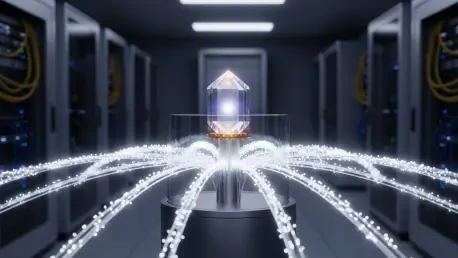
One of the most promising techniques involves a phenomenon known as electromagnetically induced transparency, or EIT, which allows a normally opaque medium to become transparent under specific laser conditions. By cooling a cloud of rubidium or cesium atoms to near absolute zero, scientists can create a controlled environment where the speed of light is drastically reduced. When a secondary “control” laser is switched off while a signal photon is inside this atomic cloud, the light’s information is effectively mapped onto the collective spin states of the atoms themselves. This transformation converts a flying qubit into a stationary one, preserving the phase and polarization of the original signal for several milliseconds. While a few milliseconds might seem brief, in the context of light speed, it is an eternity that allows for complex routing decisions and synchronization across different nodes of a network. This method represents a significant leap forward because it maintains the high fidelity required.
Solid State Storage in Doped Crystals
Refinement of these EIT systems has led to the development of solid-state alternatives, such as rare-earth-ion-doped crystals, which offer more stability than gaseous vapors in real-world environments. These crystals can function as compact “quantum hard drives” by utilizing the stable electron and nuclear spins within the lattice to store information. The primary challenge currently faced is extending the storage time from milliseconds to seconds, which would enable communication between cities or even across continents. To achieve this, researchers are employing sophisticated magnetic shielding and advanced cryogenic cooling systems to minimize external interference that causes decoherence. As these devices become more resilient, they transition from laboratory setups to robust components that can be integrated into existing telecommunications racks. The integration of solid-state quantum memory into standard fiber networks marks the beginning of a shift toward a hybrid infrastructure where classical and quantum data coexist.
Building the Quantum Internet Backbone
Quantum Repeaters: Overcoming Signal Loss
Without the ability to store and re-emit light, quantum signals are limited by the physical attenuation of fiber optic cables, which typically lose significant signal strength after roughly one hundred kilometers. Standard classical amplifiers cannot be used because the “no-cloning theorem” prevents the duplication of an unknown quantum state. This is where quantum repeaters, powered by light-pausing technology, become the critical infrastructure of the next decade. A repeater works by creating entanglement between two short segments of the network and then performing a “Bell state measurement” to extend that entanglement across the combined distance. This process relies entirely on the precise timing of photon arrival, which is only possible if one photon can be held in a buffer while waiting for its partner to arrive from a different node. By chaining these repeaters together, engineers can theoretically create a quantum link of arbitrary length. The success of this architecture depends on the efficiency of the “pause button”.
Deployment Roadmap: Toward a Global Web
By the end of 2026, the focus had shifted toward the mass production of these repeater nodes and their deployment in metropolitan area networks. The transition from experimental testbeds to operational links required a standardized approach to interface different quantum platforms, such as trapped ions and superconducting circuits, with the photonic carriers used in networking. This interoperability was facilitated by frequency conversion modules that translated specific wavelengths used for storage into the low-loss infrared bands used in commercial fiber optics. By effectively “freezing” light at the network edges, operators successfully bypassed the distance limitations that previously confined quantum experiments to small campuses. This evolution provided a clear path toward a global quantum internet where sensitive financial data was shared with absolute security. The strategic implementation of these technologies addressed the immediate need for scalable quantum security, ensuring that decentralized webs were the standard for global expansion.