
The global race for artificial intelligence dominance has reached a stage where the primary bottleneck is no longer just the development of software or the procurement of chips, but the physical infrastructure required to house these resources. Alibaba Cloud has addressed this systemic challenge by significantly reducing the total time needed to build and deliver specialized AI data centers to just 100 days. This shift signals a major transformation in the industry, moving the competitive front line from the high-tech laboratory directly to the construction site. By slashing delivery timelines, Alibaba is effectively solving a critical market pain point where the speed of high-end hardware acquisition often outpaces the slow, traditional methods of building specialized facilities. As organizations look to 2026 and beyond, the ability to deploy compute power at the speed of business demand has become a defining characteristic of market leadership. This rapid deployment strategy allows for a more agile response to the ever-changing needs of the global digital economy.
Transitioning to Modular Design Architecture
Shifting from Sequential Construction to Parallel Assembly
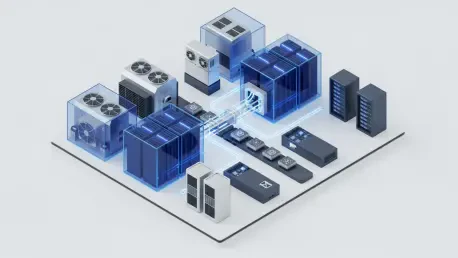
At the core of this operational breakthrough is a comprehensive transition from bespoke civil engineering to a fully integrated modular design architecture. Unlike traditional data center construction, which follows a rigid, linear process where each individual step must be completed before the next can even begin, Alibaba’s approach utilizes standardized, factory-built building blocks. While the physical site is being prepared with foundation work and utility connections, critical components such as power distribution units, liquid cooling systems, and high-density server racks are pre-assembled in a controlled factory environment. This allows for a massive parallel workflow that significantly compresses the timeline. By moving the majority of the complex mechanical and electrical work away from the messy unpredictability of a construction site and into a precision manufacturing facility, the company achieves a level of quality control and speed that was previously thought impossible.
The integration of these pre-fabricated modules on-site resembles a large-scale industrial assembly more than a traditional construction project. Each module is designed as a self-contained unit that includes its own structural support, thermal management, and networking interfaces. Once transported to the data center location, these modules are simply hoisted into place and plugged in to the main utility spine of the building. This effective decoupling of construction stages means that the deployment of the actual computing hardware can happen almost immediately after the modules are secured. The 100-day delivery window is not just a target but a repeatable performance metric made possible by eliminating the common delays associated with on-site welding, custom piping, and complex electrical wiring. This modularity also allows for easier future upgrades, as individual sections can be swapped out for newer technology without disrupting the operations of the entire facility or requiring a complete rebuild.
Scaling Global Infrastructure as a Repeatable Product
A key trend in this strategic shift is the productization of infrastructure, where data centers are treated as repeatable products rather than unique, site-specific projects. Traditionally, building a computing facility was heavily influenced by local terrain, climate variations, and regional labor availability, which made rapid global expansion an incredibly difficult and inconsistent task. By standardizing its modular designs, Alibaba can now deploy the same high-performance AI architecture across different geographical regions with minimal modifications. This consistency ensures that customers receive the same level of performance and reliability regardless of where their data is being processed. The ability to replicate a successful design template across diverse markets allows the firm to bypass the learning curves typically associated with entering new regions, transforming infrastructure from a localized hurdle into a global competitive advantage.
Industry leaders recognized that infrastructure agility was a primary determinant for success in the era of large-scale artificial intelligence. Alibaba Cloud demonstrated that by treating data centers as modular products, companies could overcome the physical constraints that once slowed digital progress. Decision-makers were encouraged to view facility construction not as a static sunk cost, but as a dynamic component of the supply chain that required the same level of optimization as the silicon chips themselves. To maintain this momentum, organizations had to prioritize standardized interfaces and factory-integrated cooling solutions to ensure full compatibility with next-generation accelerators. This shift allowed for a more resilient and elastic cloud presence that could react to sudden spikes in demand across diverse global markets. As the focus shifted from simple capacity to the absolute speed of deployment, the 100-day benchmark established a new standard for the entire technology sector.