
The transition from traditional mechanical hard drives to solid-state technology has redefined expectations for portability and durability in the personal data storage industry. As users generate increasingly massive volumes of high-definition content, the reliance on remote servers managed by massive tech conglomerates is beginning to show its practical limitations. While the convenience of anywhere access initially drove millions toward subscription-based cloud platforms, the hidden costs and performance bottlenecks are becoming harder to ignore in a landscape demanding instant data retrieval. Modern consumers are finding that the “rental” mindset of cloud storage often leads to a perpetual financial burden that scales poorly with their growing digital footprints. This shift is not merely about cost but involves a fundamental re-evaluation of how individuals interact with their most sensitive digital assets. By choosing local hardware, users reclaim a sense of agency that is frequently lost when data is stored in the ether.
Escaping the Cycle of Subscription Fees
The economic argument for local storage becomes undeniable when examining the cumulative costs of popular cloud tiers over a multi-year period. Most providers offer limited free storage, quickly forcing users into paid plans that can range from a few dollars to significant monthly expenses as their libraries of 4K video and high-resolution photography expand. Over a typical hardware lifecycle, these recurring fees often exceed the price of a high-capacity external SSD several times over. Unlike a cloud subscription, which provides no equity and can be terminated for nonpayment, a physical drive is a one-time capital investment that delivers consistent utility without further financial obligation. This predictable expenditure model is particularly attractive in the current economic environment, where subscription fatigue has reached a breaking point. By owning the hardware, users insulate themselves from the price hikes and policy changes that have become common among major cloud service providers lately.
Beyond the immediate financial savings, local storage offers a level of data sovereignty and privacy that third-party cloud providers simply cannot match. When data is stored on a remote server, it is subject to the terms of service, security protocols, and even the surveillance capabilities of the hosting company. Recent high-profile data breaches and unauthorized access incidents have highlighted the inherent vulnerabilities of centralized storage systems. In contrast, keeping sensitive documents, personal archives, and professional projects on a physical device in one’s immediate possession eliminates the middleman and reduces the attack surface for potential cyber threats. This physical control ensures that access is restricted to the owner, providing peace of mind that no algorithm or automated system is scanning personal files for metadata or training purposes. For many, the ability to disconnect from the grid while maintaining full access to their digital library is an essential component of modern privacy.
Samsung T9 for Premium Performance
For users who demand the pinnacle of performance and physical resilience, the Samsung T9 represents a significant leap forward in external storage technology. This drive leverages the sophisticated USB 3.2 Gen 2×2 interface, which enables theoretical read and write speeds of up to 2,000 MBps, effectively doubling the throughput of many previous-generation devices. Such extreme speeds are critical for professionals working with massive file sizes, such as video editors handling raw 8K footage or developers managing expansive software repositories. The internal architecture is optimized to maintain high performance even during sustained transfers, preventing the frustrating slowdowns that often plague cheaper drives. Furthermore, the external casing is engineered for durability, featuring a ruggedized shell that can withstand significant drops and harsh environmental conditions. This combination of high-speed data processing and physical toughness makes the T9 a reliable companion for those who work in demanding field environments.
The versatility of the Samsung T9 extends beyond its raw speed, offering seamless compatibility across a diverse range of platforms including Windows, macOS, Android, and the latest gaming consoles. This cross-platform utility ensures that users can move large data sets between different ecosystems without encountering formatting hurdles or driver issues. Professional reviewers often cite the consistent performance and thermal management of the T9 as its most defining characteristics, as it manages to stay relatively cool even when under a heavy workload. While the drive does require specific hardware that supports the Gen 2×2 interface to reach its maximum advertised speeds, it remains backward compatible with older USB ports, providing a future-proof solution for the coming years. For those who view their digital storage as a critical part of their professional infrastructure, the premium price point of the Samsung T9 is justified by its long-term reliability and the brand’s established reputation for quality in the memory market.
Affordable Speed With ADATA SE880
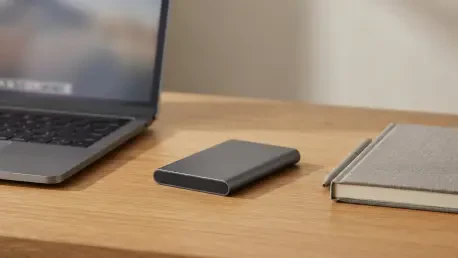
Recognizing that not every user requires the industrial-grade durability of premium models, the ADATA SE880 emerges as a highly efficient alternative that prioritizes a high price-to-performance ratio. Despite being positioned at a more accessible price point, the SE880 remarkably matches the 2,000 MBps transfer speeds found in its more expensive counterparts. It utilizes the same advanced USB 3.2 Gen 2×2 interface, packaged within an incredibly compact form factor that is often compared to the size of a pocket lighter. This portability makes it an excellent choice for students, office workers, and casual users who need to carry high-capacity storage in a pocket or small bag. The drive offers a streamlined experience for those who need fast data backups or additional space for a growing library of games and media. By focusing on the core requirement of speed without adding the cost of ruggedized shells, ADATA provides a powerful tool for cost-conscious consumers who still want top-tier performance.
While the SE880 offers impressive benchmarks for its size and price, potential buyers must consider the trade-offs involved in selecting a budget-oriented high-speed drive. Unlike its premium rivals, the ADATA model lacks integrated hardware-based encryption and specialized physical protection features, making it less suitable for those handling highly sensitive data or working in volatile environments. Expert testing has also indicated that the drive may experience some speed throttling during exceptionally long, continuous data writes as it manages internal heat within its tiny chassis. However, for standard daily tasks like moving large document folders or backing up a smartphone’s photo gallery, these limitations are rarely encountered by the average user. The inclusion of a five-year warranty suggests a strong level of manufacturer confidence in the product’s longevity, which helps mitigate concerns about its long-term reliability. It stands as a testament to the democratization of high-speed storage technology.
Making the Best Storage Investment
The decision to move away from cloud subscriptions in favor of local SSD hardware marks a significant shift toward digital ownership and self-sufficiency. As the cost of NAND flash memory continues to stabilize despite the pressures of the global AI boom, the value proposition of owning high-speed physical storage has never been stronger. Whether a user selects a professional-grade device like the Samsung T9 for its physical resilience or the ADATA SE880 for its sheer value, the underlying benefit remains the same: the elimination of perpetual monthly costs. This transition allows individuals to build a personalized storage infrastructure that is tailored to their specific performance needs and security requirements. For heavy data users, the increased bandwidth provided by local connections—reaching thousands of megabytes per second—vastly outperforms the variable speeds of cloud uploads and downloads. This efficiency gain translates directly into time saved, which is a valuable return.
Looking toward the progression of technology from 2026 to 2028, the trajectory of data management clearly favored local processing and storage solutions that integrated seamlessly with personal workflows. Users who transitioned to high-performance SSDs found themselves better equipped to handle the increasingly large datasets associated with high-fidelity media and complex software environments. To maximize this investment, it was advisable to maintain a secondary physical backup for catastrophic recovery, ensuring a redundant and robust data strategy. The shift toward high-speed local hardware was not just a reaction to rising costs but a proactive step toward building a more private and efficient digital life. By prioritizing hardware that offered a balance of speed and reliability, consumers effectively decoupled themselves from the restrictive nature of subscription models. Ultimately, the move to local storage was a logical progression for those who sought greater control and faster access.