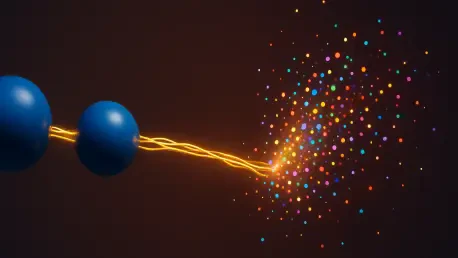

While classical computers can still verify models involving thirteen ions, quantum simulators are rapidly approaching a scale that will soon surpass the world’s most powerful supercomputers. This technological shift is allowing researchers to investigate the most elusive mechanisms of the subatomic world, specifically the phenomenon known as string breaking. In high-energy physics, this process describes how the concentrated energy within the fields that bind quarks together can spontaneously transform into matter. Quarks are never observed in isolation due to a property called confinement, which tethers them together via the strong nuclear force. When these particles are pulled apart, the tension increases until the connection snaps, resulting in the birth of new particle pairs. By recreating this event within a controlled ion-trap environment, scientists have effectively turned a laboratory setup into a specialized window into the early universe’s chaotic formation and development.
Mechanics of Quark Confinement: Energy Conversion
To understand why this simulation is so impactful, one must consider the unique behavior of the strong force that governs the internal structure of protons and neutrons. Unlike electromagnetism, which grows weaker as the distance between charged particles increases, the force between quarks remains constant regardless of how far they are stretched. This behavior is often compared to a relativistic string or a robust rubber band that stores potential energy as it is elongated. At a certain critical threshold, the amount of energy stored in this stretched string becomes greater than the mass required to create two entirely new quarks. This study successfully modeled the precise moment of this transition, demonstrating how nature prefers to create new matter rather than allow a quark to exist in a state of isolation. This fundamental resistance to separation is what defines the stability of the physical world as it is known today, providing a foundation for all matter in the cosmos.
The conversion of this concentrated energy into tangible mass follows the principles established by the most famous equation in physics, $E = mc^2$. In the context of string breaking, the rupture of the force field releases a burst of energy that materializes into a particle and an antiparticle. This dynamic is a cornerstone of the Standard Model of particle physics, yet it is notoriously difficult to observe directly because it occurs at incredibly small scales and extreme energy densities. Historically, such observations were the exclusive domain of massive facilities like the Large Hadron Collider, where particles are smashed together at near-light speeds. By using a quantum simulator, the team at the Duke Quantum Center bypassed the need for such destructive collisions, instead using the delicate interplay of quantum states to mirror the same high-energy outcomes. This achievement marks a transition from purely observational physics to a more predictive, constructive era of particle research.
Technical Implementation: Performance Validation
The experimental architecture relied on an array of thirteen ytterbium ions, each meticulously suspended in a vacuum by oscillating electromagnetic fields. These ions served as the individual qubits, or quantum bits, that encoded the complex mathematical information required to represent the quark-gluon strings. The researchers utilized a series of precisely tuned laser pulses to manipulate the internal energy states of these atoms, effectively programming the system to behave according to the laws of quantum chromodynamics. By adjusting the frequency and duration of the laser interactions, the scientists could simulate the increasing tension between subatomic particles with a level of granularity that was previously impossible. This high-fidelity control over individual atoms allowed the team to observe the evolution of the system in real-time, providing a frame-by-frame view of how quantum fields fluctuate and eventually stabilize after a simulated rupture event within the vacuum.
A vital component of the methodology involved initializing the ion chain in an out-of-equilibrium state, which is a condition where the system is forced to seek a new stable configuration over time. This dynamic instability was necessary to mimic the rapid expansion and cooling that occurred during the first fractions of a second after the Big Bang. As the simulation progressed, the researchers monitored the emergence of what they termed effective charges within the chain. These charges were the digital signatures of new particles popping into existence from the energy of the simulated string. By tracking these signatures as they propagated through the ion array, the team reconstructed the entire life cycle of the string-breaking event. This approach demonstrated that trapped ion systems are uniquely suited for these types of simulations due to their long coherence times and the ability to maintain complex correlations across the entire chain of particles throughout the process.
Strategic Outlook: Cosmology and Quantum Research
Before the scientific community could fully accept these results, the Duke team performed a rigorous validation process by comparing their quantum data with results from a high-performance classical computer. This comparison confirmed that the interactions observed in the 13-ion system were genuine representations of subatomic physics. This research was part of a larger, multi-institutional effort to benchmark different quantum architectures, alongside teams at Google and QuEra Computing who explored similar phenomena using superconducting circuits and neutral atoms. The fact that these three distinct technologies reached the same conclusions provides a robust cross-platform validation that is rare in this technological era. The trapped ion approach used at Duke offered particularly high levels of connectivity, allowing every ion in the chain to interact with every other ion. This capability is critical for modeling the intricate connections that define the strong force, giving the Duke team a distinct advantage in precision.
Moving forward, the focus shifted toward scaling these ion-trap systems to handle even more complex simulations involving higher dimensions and more varied particle types. The success of the 13-ion model offered a clear path for expansion, suggesting that subsequent experiments could incorporate hundreds of ions to simulate the behavior of entire nuclei rather than just individual strings. Researchers and institutions prioritized the development of more robust error-correction protocols and improved laser stability to maintain coherence as systems grew in size. By investing in these technical refinements from 2026 to 2030, the scientific community unlocked the ability to simulate first-light events and the synthesis of heavy elements with unprecedented precision. This study demonstrated that the tools for these discoveries were no longer theoretical; they were operational in specialized labs, ready to redefine the boundaries of human knowledge and provide actionable insights into the fundamental mechanisms that govern our physical reality.