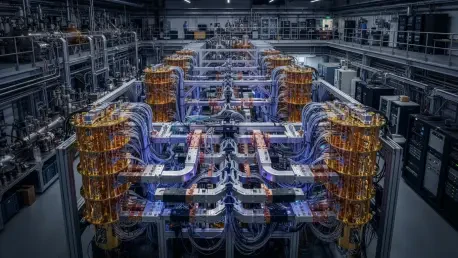

The transition from experimental prototypes to enterprise-grade quantum computers requires a shift away from the restrictive boundaries of monolithic chip architectures. As the industry advances through 2026, the logistical burden of cooling, wiring, and maintaining signal integrity on a single silicon wafer has become nearly impossible to manage for systems targeting thousands of qubits. Engineers have realized that simply shrinking components is no longer sufficient to overcome the thermal and electromagnetic noise that plagues high-density quantum processors. To address this bottleneck, a significant movement toward modularity has emerged, seeking ways to link multiple independent processors into a unified network that behaves like a single, massive machine. Recent breakthroughs in interconnect technology have demonstrated that it is now possible to bypass the physical limits of a single chip by connecting disparate processors with high-fidelity links, essentially turning separate units into a scalable fabric.
Breaking the Single-Chip Barrier: The Role of L-Couplers
The introduction of l-couplers represents a strategic pivot in quantum hardware design, specifically moving beyond the short-range c-couplers that have traditionally managed on-chip communication. Unlike these local links, l-couplers are long-range interconnects designed to span distances of nearly a meter within the extreme cold of a cryogenic environment. This development is crucial because it allows researchers to physically separate the processing units, reducing the density of heat-generating control electronics that otherwise threaten the stability of the qubits. By facilitating communication between independent superconducting processors, these links allow multiple chips to function as a singular computational unit. This modular framework is essential for building the massive qubit arrays required for the next generation of enterprise-grade applications, providing a clear path to scale without the engineering nightmare of packaging everything onto one fragile silicon wafer.
Recent experimental benchmarks have confirmed that these meter-scale links can maintain the fragile state of quantum information with remarkable precision. Research involving two quantum processors linked by aluminum coaxial l-couplers achieved an average state transfer fidelity of 99 percent, with peak performance reaching 99.3 percent. These figures indicate that quantum data can travel across an 80-centimeter cable with almost no loss of coherence, proving that physical distance is no longer a deal-breaker for quantum connectivity. This level of performance was previously thought to be impossible due to the high likelihood of decoherence occurring over such a long physical path. However, the successful implementation of superconducting coaxial lines has minimized signal loss, ensuring that the quantum state remains intact as it moves from one module to the next. This breakthrough provides a reliable foundation for connecting the islands of processing power necessary for fault tolerance.
Technical Benchmarks: Logic Gate Performance and Fidelity
Beyond simple data transfer, the success of a modular system depends on the ability to perform complex operations across different chips without introducing prohibitive amounts of noise. Engineers have successfully executed distant logic gates, which are fundamental for creating entanglement between qubits located on separate processors. With an average two-qubit gate fidelity of approximately 94.75 percent, these links enable the distributed execution of quantum algorithms that were previously restricted to single-chip environments. This capability ensures that the modular network is not just a collection of parts, but a cohesive machine capable of high-level logic across a decentralized architecture. The ability to entangle qubits across meter-scale distances allows for a more flexible layout of quantum hardware, where processors can be optimized for specific tasks while still participating in a larger, unified computational process that spans multiple specialized zones within the system.
The internal quality factors of these couplers further validate their readiness for industrial use in large-scale deployments. Reaching a quality factor in the range of 940,000 confirms that the system can store and transmit energy with extremely low dissipation, a necessity for maintaining the delicate environments of superconducting qubits. This technical milestone meets the rigorous standards required for modern hardware, ensuring that the l-couplers can handle the demands of a high-performance computing environment without introducing significant noise or energy loss. This high quality factor is a direct result of advanced material science and shielding techniques used in the construction of the aluminum coaxial lines. By reducing the interaction between the quantum signal and the surrounding environment, designers have successfully mitigated the primary sources of error that historically hindered long-distance quantum communication, paving the way for truly massive quantum networks.
Engineering Challenges: Scalability and Practical Implementation
One of the most innovative aspects of this new interconnect design is its focus on ease of assembly and maintenance, addressing the physical logistics of quantum data centers. In the past, connecting quantum chips often required bespoke, permanent setups that were difficult to reproduce, repair, or upgrade without dismantling the entire cooling apparatus. The modern l-coupler is designed as an integrated component stack that can be installed after the main processor payloads are already mounted inside a dilution refrigerator. This post-mounting installation capability is a game-changer for the industry, as it allows for a more standardized assembly line approach to building quantum computers. It reduces the risk of damaging sensitive processors during the complex wiring phase and simplifies the integration of multiple chips within a single cryogenic unit. This shift toward modular installation reflects a maturing industry that is prioritizing operational efficiency and reliability.
The plug-and-play capability of this architecture allows technicians to expand or service the system without having to redesign the entire core architecture or commit to a static hardware configuration. If a single processor module fails or requires an upgrade to a newer generation of qubits, it can be replaced or serviced while the rest of the modular framework remains intact. This approach significantly lowers the total cost of ownership for quantum systems and ensures that they can evolve as technology improves. Furthermore, the standardization of these l-coupler interfaces means that different types of processors could potentially be linked together, creating a heterogeneous computing environment. This flexibility is vital for researchers and enterprise users who need to customize their quantum resources for specific computational tasks, ranging from chemical simulation to complex financial modeling, without being locked into a rigid, monolithic hardware design.
The Future Landscape: Shifting to Modular Cryogenics
The industry is currently shifting toward modular cryogenics, where large-scale refrigerators house multiple processor payloads in a shared environment. This move away from the traditional one-chip-per-fridge model allows for much higher qubit density and more efficient scaling of the overall system infrastructure. By linking these islands of processing power through meter-scale channels, researchers can build the sprawling infrastructure necessary for advanced error-correction protocols, which require thousands of physical qubits to create a single logical qubit. This strategy ensures that the power of a quantum computer is defined by the reach of its network rather than the surface area of a single silicon wafer. The consolidation of multiple processors into a single cryogenic environment also reduces the footprint and power consumption of the overall facility, making the deployment of enterprise-grade quantum systems more sustainable and practical for various data center environments.
The transition toward these robust modular systems was facilitated by the successful validation of interconnect technologies that prioritized fidelity and ease of use. Engineers observed that the ability to link processors without significant performance penalties allowed for more ambitious architectural designs that were previously constrained by physics. This research proved that a modular approach could effectively handle the demands of error correction while maintaining high coherence across distributed nodes. The findings suggested that the industry was no longer limited by the boundaries of a single silicon wafer, as the meter-scale links demonstrated a reliable path for scaling. By establishing this hardware foundation, the team provided a clear blueprint for future enterprise-grade installations. This development essentially shifted the focus from theoretical scalability to practical engineering, ensuring that the next generation of computers would be built on a flexible and resilient network.