
Future advancements in computing depend on a model that can provide automated optimization and verification of computational complexity to guide resource scheduling. As the boundaries of traditional silicon-based processing are pushed to their physical limits, the integration of quantum mechanical properties into everyday computational tasks has transitioned from a theoretical dream to an engineering necessity. Researchers at the Information Engineering University in Zhengzhou, China, recognized that while quantum hardware is advancing at a breakneck pace, the industry has lacked a rigorous mathematical structure to unify these disparate worlds. Their development of the Hybrid Turing Machine (HTM) provides this long-sought bridge, moving the conversation away from experimental guesswork toward a formalized scientific standard. By defining a unified set of states and transition functions, the HTM model allows for a cohesive operational flow where classical and quantum processors no longer function as isolated silos but as a synchronized engine. This advancement represents a fundamental shift in how developers approach high-performance computing, providing a reliable blueprint that ensures both efficiency and scalability in systems that must process a mix of binary and quantum data simultaneously.
Bridging Classical Foundations: The Evolution of Computability
To fully appreciate the significance of the Hybrid Turing Machine, one must examine the historical trajectory of computer science that began with Alan Turing’s seminal work in 1936. For nearly a century, the Church-Turing Thesis served as the immutable bedrock of all mechanical calculation, providing a universal language for what could be computed using binary logic. However, as the 21st century unfolded, the emergence of quantum computing introduced a paradigm that the original Turing machine was never equipped to handle. While researchers eventually conceptualized the Quantum Turing Machine (QTM) to explore the possibilities of superposition and entanglement, the practical reality of 2026 is that most advanced systems operate in a hybrid capacity. The HTM model addresses this by extending the classic single-controller architecture to manage the dual-nature requirements of modern processing, effectively updating the very foundations of the field to reflect a reality where classical bits and quantum qubits must coexist and interact within a single computational cycle.
This modern extension of Turing’s work represents a transition from “ad hoc” engineering—where developers often use trial and error to integrate different hardware—to a structured scientific approach that guarantees computational integrity. Prior to the HTM, there was no standardized theoretical template for how a single controller could orchestrate the simultaneous movement of classical and quantum data. This lack of a formal model often led to significant inefficiencies, as the handover of tasks between a Central Processing Unit (CPU) and a Quantum Processing Unit (QPU) was managed through loosely integrated interfaces that lacked mathematical precision. By providing a rigorous framework, the researchers in Zhengzhou have moved the industry beyond the basic question of whether hybrid computation is feasible. They have instead provided a comprehensive “how,” offering a way to construct systems that are both theoretically sound and practically scalable for the increasingly demanding workloads of the current decade.
Unified Control Architecture: A Dual-Head Approach
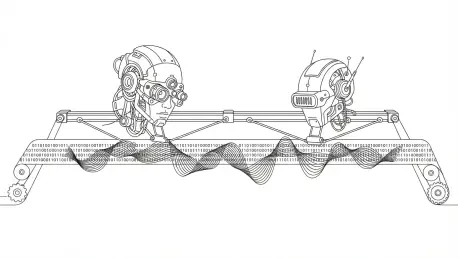
The architecture of the HTM is defined by its innovative use of two independent read/write heads—one dedicated to classical operations and the other to quantum transformations—operating under a single unified controller. This configuration is distinct from previous hybrid attempts that simply linked two separate machines with a communication cable. In the HTM model, both heads work on a shared computational tape that serves as the medium for all data processing. The unified controller, denoted in technical documentation as Cf, acts as the central brain of the operation, ensuring that instructions are dispatched to the appropriate head based on the nature of the task. This setup allows the system to maintain the deterministic reliability of classical Boolean logic for administrative tasks while simultaneously harnessing the exponential processing power of quantum state transformations for complex algorithmic calculations.
To prevent logical conflicts and maintain the delicate balance of a hybrid environment, the HTM utilizes a sophisticated control-sharing mechanism. This mechanism is critical for ensuring synchronization; when the quantum head is engaged in performing complex state transformations, the classical head is programmed to pause its operations. This design ensures that the system maintains unitarity, a fundamental requirement of quantum mechanics that prevents the loss of information during processing. Once the quantum operation is finalized and a measurement is taken, an interrupt signal is sent back to the controller, allowing the classical head to resume its duties and process the results. This orchestration ensures that the classical control overhead remains within manageable polynomial limits while the quantum component provides the necessary acceleration to solve problems that would otherwise be computationally impossible for a traditional system.
Mathematical Foundations: Assessing Computational Complexity
A major hurdle in the development of efficient hybrid systems has been the “task partitioning” problem, which involves determining exactly which parts of a complex algorithm should be assigned to the quantum head and which should remain with the classical processor. The HTM model introduces a comprehensive method for calculating this complexity, rooted in the principles of entanglement and superposition. By utilizing Dirac notation to track the system’s states across discrete time steps, the model provides a mathematical way to quantify the specific “cost” associated with transforming an initial state into a desired target state. This is not merely a theoretical exercise; it provides the operational foundation required to measure how much energy and time a specific micro-operation will consume, allowing for a much more precise level of resource management than was previously possible in the industry.
This mathematical approach has immediate and profound practical implications for automated resource scheduling in high-performance environments. By assessing the operational foundations of complexity at the most granular level, the HTM enables what researchers call “fine-grained” scheduling. In this scenario, the system can automatically and reliably decide how to decompose a massive computational task, assigning high-entanglement operations to the quantum head while reserving linear logic for the classical head. This advancement moves the technology sector away from manual, intuition-based programming, which is prone to human error and inefficiency. Instead, the HTM allows for an automated, optimized system of allocating micro-operations based on their specific logic requirements, ensuring that every cycle of the processor is used to its maximum potential without wasting expensive quantum resources on tasks that a classical head can perform more simply.
Theoretical Synthesis: Formalizing Modern Hybrid Frameworks
The Hybrid Turing Machine model was not created in a vacuum but was designed to complement and formalize the ongoing work within existing software ecosystems. Major platforms such as IBM’s Qiskit and Google’s Cirq have already laid the groundwork for linking quantum software with physical hardware, but they have often functioned without a unified theoretical description of the transition mechanisms involved. The HTM provides the “theoretical bedrock” that these practical frameworks have lacked, offering a standardized description of the state spaces and transition functions that govern hybrid interactions. By resolving the inconsistencies found in current integration devices, the HTM serves as a guiding light for future development, ensuring that the software used to program these machines and the hardware used to run them can advance in lockstep rather than drifting apart in separate engineering silos.
As global supercomputing centers increasingly integrate these technologies to use classical systems for data preprocessing and quantum devices for combinatorial optimization, the clarity provided by the HTM becomes essential. It addresses the theoretical shortages that have historically led to processing delays or inefficient power consumption in contemporary hybrid devices. By providing a clear logic for instruction dispatching, the model ensures that the interaction between different processing units is seamless and predictable. This level of standardization is expected to accelerate the adoption of hybrid systems in fields such as cryptography, materials science, and climate modeling, where the ability to accurately predict and manage computational costs is just as important as the raw speed of the processor itself. The HTM thus provides a necessary bridge between the abstract world of quantum theory and the practical demands of modern industrial computing.
Practical Implementation: Shaping Future Hardware Integration
The introduction of the HTM model provided a necessary pivot from empirical engineering to a structured theoretical framework that defined the next era of computing. By standardizing the interaction between classical and quantum components, the research team offered a viable path forward for the next generation of integrated supercomputing systems. This development allowed hardware architects to move away from the “ad hoc” methods that characterized early hybrid systems, replacing them with a mathematically rigorous approach to resource allocation. As the industry integrated these principles into new development cycles starting from 2026, the focus shifted toward optimizing the control protocols and interaction interfaces defined by the HTM. This model ultimately paved the way for more sophisticated adaptive task partitioning, ensuring that the theoretical gap between two once-disparate computational worlds was finally closed for good.
Future engineering efforts resulting from this research focused on refining the physical interfaces between the dual read/write heads to minimize latency during the transition of control signals. The standardized logic of the HTM allowed for the creation of universal drivers that could work across different quantum hardware architectures, whether they were based on superconducting loops or trapped ions. This interoperability proved to be a critical factor in the widespread commercialization of hybrid computers, as it reduced the specialized knowledge required to build and maintain these systems. The resulting advancements demonstrated that a unified system is far more powerful than the sum of its parts, establishing a new baseline for global computing standards and proving that the joint advancement of models and hardware is the most effective way to solve the world’s most complex mathematical challenges.