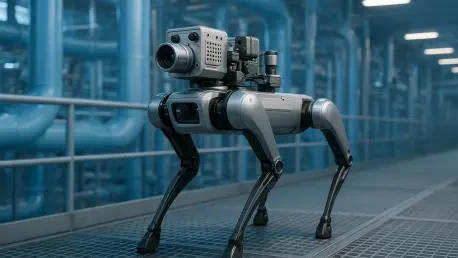

A water cannon mounted on a quadruped platform can discharge foam at 40 liters per second, providing fire suppression in areas too dangerous for human entry. The transition to legged robotics in the emergency sector represents a pivotal shift in how agencies manage high-risk scenarios. In 2026, the deployment of these units has moved beyond experimental trials into standardized operational protocols for fire departments. Unlike traditional wheeled drones that often become ensnared in debris, quadruped systems utilize sophisticated limb coordination to navigate fractured concrete with remarkable stability. This mobility allows for the delivery of critical payloads—ranging from medical supplies to specialized sensors—into the heart of a disaster zone. These machines mimic biological movement to remain upright on uneven surfaces, providing a persistent presence that was impossible before. By integrating these platforms, agencies are effectively extending their reach while reducing the physical exposure of human rescuers.
Navigating Structural Instability: Precision in Search and Rescue
These robotic units are equipped with a suite of advanced perception technologies, including 360-degree LiDAR and thermal imaging cameras, which enable them to construct three-dimensional maps of unstable environments in real time. When a building collapses, the structural integrity is often too compromised for human search teams to enter immediately. Quadruped robots, however, can squeeze through narrow apertures and climb over piles of rubble to locate survivors using sensitive acoustic sensors and CO2 detectors. The data gathered is instantly transmitted to a command center, allowing incident commanders to visualize the interior layout and identify the most efficient paths for extraction. This situational awareness minimizes the “blind” phase of a rescue operation, where every second is critical for life-saving efforts. The low center of gravity and contact provided by the legs allow the robot to maintain traction on slick surfaces where traditional wheeled platforms would simply spin.
Beyond physical navigation, these machines serve as critical communication bridges in environments where radio signals are frequently degraded or completely blocked. In deep subterranean tunnels or reinforced concrete structures, the robots act as mobile mesh network nodes, extending the range of wireless communication for the entire rescue team. By positioning themselves at strategic intervals, they create a continuous data relay that supports high-definition video feeds and biometric monitoring of personnel working inside the hot zone. This capability ensures that rescuers remain connected to their supervisors, enhancing the safety and coordination of the mission. The modular nature of these platforms also allows for the rapid swapping of sensor payloads, meaning a single robot can transition from a search-and-rescue configuration to a structural assessment tool within minutes. This versatility is essential for departments that must maximize the utility of their technological investments.
Mitigating Hazardous Risks: Chemical and Radiological Defense
Hazardous material incidents pose a unique set of challenges where even the most advanced protective suits cannot guarantee total safety for human technicians. In 2026, quadruped robots have become the primary tools for initial site assessment in the event of chemical spills or radiological leaks. These units carry specialized spectrometers and gas chromatographs that can identify thousands of distinct chemical compounds. Because they can move autonomously or be remote-controlled from a safe distance, they are used to mark boundaries of contaminated zones and collect physical samples for laboratory analysis. The articulated limbs allow the robot to manipulate valves or open heavy doors that would hinder a standard wheeled rover. This physical dexterity, combined with high-grade environmental sealing, ensures that the robot can operate in corrosive atmospheres. By deploying a robotic scout first, hazmat teams can develop a precise mitigation strategy, leading to faster and more reliable containment.
The implementation of quadruped systems within the emergency response framework established a new baseline for operational safety. It was recognized that the successful integration of these robots required not only hardware acquisition but also a fundamental restructuring of training programs. Looking ahead, the focus moved toward the development of heterogeneous swarms, where multiple units coordinate their movements to cover larger areas in shorter timeframes. Agencies prioritized the standardization of software interfaces to ensure that different robotic platforms could communicate seamlessly during multi-jurisdictional disasters. The investment in robust data-processing became paramount, as the volume of information generated necessitated automated filtering to prevent cognitive overload. Moving forward, the industry addressed the need for longer battery life and improved autonomous decision-making. By adopting these strategies, organizations ensured that the technological momentum was sustained.