
Traditional infrared sensors often struggle to capture the complex intersection of spectral data and polarization states without relying on bulky mechanical components. Historically, this limitation confined advanced chemical analysis to lab settings where heavy equipment was the norm. However, a significant shift occurred as researchers integrated artificial intelligence with revolutionary meta-optics to redefine sensing boundaries. Modern systems moved beyond simple light intensity to embrace hyperspectropolarimetric sensing, a multidimensional approach recording spatial, spectral, and polarimetric data. By leveraging subwavelength optical manipulation alongside sophisticated neural networks, these devices now extract distinct material fingerprints and surface textures in real time. This technological convergence represents a fundamental change in how information is harvested from the electromagnetic spectrum, turning thin-film materials into powerful analytical engines that analyze chemical structures instantly.
Integrating Metasurfaces: The Role of Compact Optical Encoding
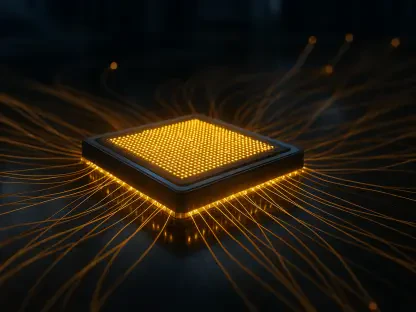
At the core of this hardware revolution is the infrared metasurface, a flat optical component composed of meticulously engineered microscopic structures known as meta-atoms. Unlike standard glass lenses that rely on physical thickness to bend light through refraction, these subwavelength elements manipulate the phase, amplitude, and polarization of radiation at a molecular level. This precise control allows the sensor to perform multiplexing, which is the intricate process of encoding complex spectral and polarization signatures directly into a single, compressed raw data stream. By utilizing these nanostructures, engineers force light to interact with the detector in ways that were previously impossible with traditional refractive optics. The result is a highly condensed information set that contains all the necessary data points regarding the chemical and physical nature of the scene, packaged within a form factor that is barely thicker than a human hair or a standard coating.
This architectural transformation is primarily driven by the elimination of heavy, mechanical parts such as rotating filter wheels and scanning arms that once defined hyperspectral cameras. In their place, the hardware-software synergy allows for a device that is small enough for mobile platforms while remaining significantly more powerful than its predecessors. This design is particularly essential for modern applications where weight and size are critical constraints, such as on autonomous drones or handheld medical diagnostic tools. While the raw output captured by the sensor is entirely unrecognizable to the human eye, it holds a dense wealth of information that serves as the foundation for digital reconstruction. This transition to a solid-state, stationary design not only increases the durability of the equipment in harsh field conditions but also dramatically reduces the power consumption required to operate complex imaging systems during long missions or remote monitoring.
Deep Learning: The Engine for Data Reconstruction
The primary challenge of utilizing compressed optical data lies in the inverse problem, or the extreme difficulty of untangling overlapping signals to reconstruct a usable image from a single measurement. Traditional mathematical algorithms often prove too slow or computationally intensive for practical field use, requiring massive processing power that drains mobile batteries. Deep learning solves this bottleneck by serving as a high-speed reconstruction engine capable of interpreting the chaotic data captured by the metasurface. A neural network is trained to recognize the specific, repeatable patterns in how the engineered nanostructures encode light, allowing the system to reverse the encoding process and produce detailed data cubes almost instantly. This breakthrough ensures that the bottleneck of data processing no longer hinders the speed of discovery, allowing the system to transition from basic data collection to sophisticated, intelligent interpretation in any environment.
This fundamental shift effectively moves the complexity of the imaging system from the physical hardware components to the digital software environment. Once the neural network has successfully learned the non-linear relationship between the multiplexed measurements and the physical properties of the scene, it can generate high-accuracy images at speeds that match or exceed standard video rates. Such a capability allows for a transition from static laboratory measurements, where samples must remain perfectly still, to dynamic, real-time environmental analysis. The efficiency of these AI models means that high-resolution hyperspectral data is no longer the exclusive domain of supercomputers. Instead, edge computing devices can now handle the heavy lifting of reconstruction, enabling researchers and technicians to see the hidden chemical composition of their surroundings in the field without needing a continuous connection to a centralized server or high-end workstation.
Real-Time Performance: Achieving Precision in Dynamic Environments
One of the most significant advantages of AI-driven imaging is the near-total elimination of temporal errors that plagued earlier generations of sensors. Conventional hyperspectral cameras frequently utilized push-broom scanning, a technique that captures different wavelengths sequentially as the camera or the object moves. This method is notoriously ineffective for moving targets, as any slight motion during the scan cycle creates distracting artifacts and data inconsistencies that can ruin the analysis. By capturing all necessary spectral and spatial data in a single exposure or a highly compressed sequence, the AI-enhanced metasensor ensures that dynamic scenes are captured with perfect synchronization. Whether monitoring a spreading gas cloud or a vehicle moving at high speeds, the system maintains a cohesive data set where every pixel corresponds to the exact same moment in time, providing a reliable foundation for automated decision-making and safety.
This real-time performance is vital for industrial and safety applications where every second counts toward preventing a disaster or a production error. In high-speed manufacturing environments, these sensors can identify microscopic material defects on a rapidly moving assembly line that would remain completely invisible to standard cameras. Similarly, in the field of environmental monitoring, the ability to track the rapid dispersion of hazardous gases using their unique infrared signatures provides a level of situational awareness that was previously impossible to achieve with portable equipment. The integration of AI allows the system to not only capture the data but also to prioritize specific anomalies, alerting operators to chemical leaks or structural failures as they occur. This proactive approach to sensing turns the camera into a sentinel, capable of identifying risks long before they manifest as visible problems or safety hazards to the public or the environment.
Spectral and Polarimetric DatThe Power of Infrared Identification
The strategic choice to focus on the infrared band is based on the fact that this portion of the electromagnetic spectrum contains a vast amount of information invisible to the human eye, such as thermal signatures and specific molecular vibrations. When hyperspectral sensing is applied to this range, it allows for the precise fingerprinting of various chemicals and synthetic materials like plastics. Two objects may appear identical under visible light, yet their unique infrared spectra will immediately reveal their true chemical identity and structural composition. This makes the technology invaluable for sorting materials in recycling facilities or identifying hazardous substances in security settings without needing physical contact. By analyzing the way molecules absorb and emit infrared light, the AI-integrated system provides a definitive identification that bypasses the visual camouflage or surface-level similarities that often deceive standard imaging tools.
Adding polarimetric sensing to this spectral data provides a second layer of identification by revealing the surface roughness, geometry, and orientation of an object. Polarization is highly sensitive to the physical shape and texture of a surface, as well as the specific angle of the incoming light source. By merging spectral and polarimetric data into a single analytical stream, the AI-driven metasensor provides a comprehensive physical description of the entire scene. This dual-layer approach significantly improves the accuracy of automated target detection and material classification, especially in cluttered or low-contrast environments. For example, a metallic object can be easily distinguished from a plastic one with similar thermal properties because their polarization signatures differ drastically. This fusion of data types allows for a level of machine perception that rivals the most advanced biological eyes, offering a complete profile of the material world.
Scalability and Robustness: Addressing the Challenges of Future Integration
While the fusion of meta-optics and deep learning represented a major breakthrough, several hurdles remained before the technology achieved widespread commercial adoption. The success of these systems depended heavily on the quality of the training data and the extreme precision required during the metasurface fabrication process. Developments focused on manufacturing scalability to ensure these advanced sensors were produced at a cost that allowed for mass-market integration into consumer electronics and everyday industrial tools. Furthermore, engineers worked to ensure the robustness of the AI models when they were exposed to unpredictable environments that differed significantly from their controlled training sets. Maintaining the calibration between the hardware and the software over the lifespan of the device was also a priority, as environmental wear often altered the optical response. These technical challenges necessitated a rigorous approach to both material science and algorithmic refinement.
The transition toward interpretive imaging defined a new era where cameras provided an instant, analytical understanding of the physical world rather than just a visual record. Stakeholders in the optics and sensor industries successfully prioritized the integration of computational photography with nanophotonics to overcome the rigid boundaries of classical physics. The focus shifted from merely capturing light to decoding the very essence of matter, which paved the way for smarter autonomous systems and more efficient industrial processes. As these sensors became more accessible, the requirement for manual chemical sampling decreased, replaced by non-invasive optical diagnostics. It was determined that organizations needed to invest in standardized datasets to refine neural network accuracy across diverse atmospheric conditions. Ensuring the longevity of these systems required a commitment to iterative software updates and resilient hardware design to maintain high fidelity.