
Manufacturing floors have long remained the final frontier for digital intelligence because the sheer unpredictability of moving parts and shifting priorities often breaks traditional automation logic. At the upcoming Automate 2026 trade show, the industry is witnessing a fundamental pivot as Teradyne Robotics introduces systems that can finally perceive and reason within these chaotic environments. Rather than relying on rigid, pre-programmed code that assumes a perfect world, this new wave of “Physical AI” treats the factory as a living ecosystem. This transition marks a critical move from experimental laboratory concepts to production-ready tools capable of handling the complexities of modern manufacturing where “messy reality” usually thwarts basic machines. By integrating advanced perception with real-time decision-making, these robots no longer require static environments. Instead, they thrive in the fluctuating conditions that define today’s high-speed production lines.
Integrating Sophisticated Motion Control via the PolyScope X Platform
The foundation of this evolution is the PolyScope X software platform, which modernizes motion control for the latest generation of Universal Robots. This system introduces sophisticated background logic that effectively replaces external hardware controllers, thereby streamlining the architectural design of a standard automation cell. By consolidating control within the software layer, engineers can eliminate redundant components and reduce the points of failure in complex setups. A prime example of this technology in action is the MiR1200 Pallet Jack, a dedicated Physical AI product designed to navigate dynamic warehouses with autonomous precision. Unlike older automated guided vehicles that required fixed paths or magnetic strips, this unit adapts to shifting obstacles and changing floor layouts without human intervention. This shift toward software-defined hardware allows for a level of operational agility that was previously impossible in large-scale logistics.
Mastering Nuanced Assembly Tasks with the UR AI Trainer
Teaching robots to perform nuanced, high-precision tasks has long been a significant challenge for developers, but the UR AI Trainer aims to bridge this programming gap through intuitive design. Developed in partnership with Scale AI, this platform utilizes imitation learning to allow human operators to physically guide robots through complex motions, such as those required for smartphone assembly. By capturing force-aware data and integrating it with advanced simulation frameworks, Teradyne ensures that these machines can master delicate actions before they ever set foot on a real-world production line. This methodology removes the need for lines of abstract code, replacing them with a natural demonstration of the task. Consequently, the time required to train a robot for a specialized role has been slashed from weeks to just a few hours. This approach not only speeds up deployment but also ensures that the robot can handle subtle variations in the materials it touches during the assembly process.
Overcoming Precision Dexterity Hurdles in Modern Data Centers
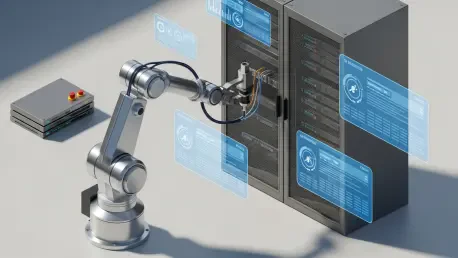
Teradyne is also focusing its Physical AI efforts on the critical infrastructure supporting global data centers and high-end electronics manufacturing. Innovative applications, such as the Cambrian system, utilize specialized AI vision to perform precision tasks like inserting copper cables into high-density server racks. This is a job that was traditionally reserved for human hands because the flexible and unpredictable nature of cables made it nearly impossible for standard robots to manage. However, with advanced vision algorithms, the robot can now “see” the orientation of the cable and adjust its grip in real-time. This level of dexterity is further supported by general-purpose foundation models that demonstrate how robotic arms can achieve the speed and accuracy required for actual factory deployments. By solving these hyper-specific technical hurdles, the industry is moving closer to a state where even the most intricate manual labor can be reliably automated.
Leveraging Global Partner Ecosystems for Specialized Applications
The strength of this decentralized approach is significantly amplified by a diverse ecosystem of partners who create adaptive solutions for specific industrial needs. From autonomous sanding systems that identify surface defects on the fly to robots that learn metal buffing by mimicking human pressure, the focus has shifted toward flexibility rather than fixed infrastructure. These collaborations highlight a broader industry movement toward fluid material flows where robots can adjust their behavior based on continuous visual and sensory feedback. For instance, a robot integrated with force-sensing technology can feel the resistance of a surface and apply the exact amount of pressure needed to achieve a perfect finish. This mimics the tactile intuition of a veteran craftsman, allowing for a level of quality control that exceeds traditional mechanical standards. Such partnerships ensure that the technology is not just powerful in a vacuum but is highly practical for niche manufacturing applications.
Implementing Conversational AI and Advanced 3D Vision Systems
Modern interfaces are further lowering the barrier to entry for small and medium-sized enterprises, with conversational AI platforms allowing operators to set up jobs using simple chat commands. This democratization of programming means that workers no longer need extensive coding knowledge or computer science degrees to deploy sophisticated robotic cells in their facilities. By using natural language in any tongue, a floor supervisor can describe a task, and the AI translates those instructions into executable robotic motions. This reduces the setup times from several days to just a few minutes, making it feasible to use automation for short-run production cycles. Additionally, advances in 3D vision have enabled precision picking systems to achieve near-perfect success rates even in unstructured or cluttered environments. This eliminates the need for the time-consuming manual programming that was once required to account for every possible object orientation on a conveyor belt.
Strategic Considerations for Modular Scaling in Global Manufacturing
Ultimately, the strategy adopted by industry leaders emphasized practical, end-to-end solutions over the speculative hype that frequently surrounded the development of humanoid robotics. By combining mobile platforms with collaborative arms and force-aware intelligence, manufacturers successfully made automation more accessible and human-like in its overall sensitivity. This philosophy fully embraced the inherent chaos of the real-world factory floor, providing operators with adaptable tools that delivered immediate value through a globally integrated network of technology. Manufacturers were encouraged to audit their existing manual assembly points to identify where flexible AI-driven vision could replace rigid fixtures. Decision-makers shifted their focus toward modular platforms that integrated seamlessly with existing warehouse management systems to ensure long-term scalability. By prioritizing these functional upgrades, companies secured their place in a landscape where the boundary between software intelligence and physical action became entirely invisible.