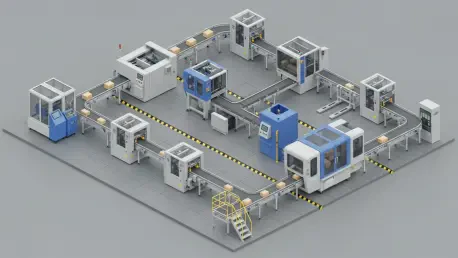

The persistent challenge of labor shortages in European manufacturing has forced a dramatic pivot toward automated solutions that can be deployed without the multi-month lead times typical of traditional industrial integration. This paradigm shift is being led by a full-stack automation platform that unifies case packing, conveying, and palletizing into a single, cohesive environment. By eliminating the silos between hardware design and software deployment, the company is enabling regional manufacturers to modernize their floor space with unprecedented speed. The strategy focuses on providing end-to-end packaging solutions that are pre-configured for rapid installation, effectively bypassing the complexities of custom engineering projects. This approach is particularly relevant for the EMEA market, where high labor costs and varying production demands require systems that are both flexible and easy to maintain. Manufacturers are no longer forced to choose between rigid legacy systems and expensive bespoke automation; instead, they are adopting modular ecosystems that scale alongside their business needs while ensuring that every component of the production line communicates seamlessly.
Integrating Intelligence With Modular Design: The Rapid Series Solution
Central to this expansion is the introduction of the third-generation Rapid Series Palletizer, a system that utilizes MachineMotion AI to synchronize mechanical movements with intelligent path planning. Traditional automation deployments often languish in development for half a year or more, yet this new technology allows for an entire end-of-line system to be operational in just twelve weeks. The palletizer itself can be installed in a mere four weeks, providing a deployment speed that is roughly three to five times faster than what was considered industry standard just a few years ago. This acceleration is made possible through the use of standardized components that arrive at the factory floor ready for assembly and immediate commissioning. By streamlining the engineering phase, companies can drastically reduce the downtime associated with line transitions and new product launches. The integration of high-level control logic into modular frames ensures that the system remains adaptable, allowing for quick reconfigurations as production requirements evolve over time.
This technological ecosystem thrives on collaboration, specifically through a strategic partnership with Universal Robots to incorporate advanced collaborative arms into the workflow. In practical applications, the UR10e handles robotic case packing with high precision, while the more robust UR20 is utilized for demanding palletizing tasks that require greater reach and payload capacity. Such a combination allows manufacturers to manage high-mix production environments where product sizes and packaging requirements change frequently. The software layer acts as a bridge, ensuring that the robotic arms work in perfect harmony with the rest of the modular assembly. This unified approach eliminates the need for specialized programming knowledge on the factory floor, as the interface is designed for intuitive use by existing staff. As a result, the barrier to entry for sophisticated automation is lowered, permitting medium-sized enterprises to compete with larger entities that have historically dominated the automation space. The synergy between modular hardware and collaborative robotics creates a resilient framework.
Infrastructure For Seamless Material Flow And Operational Clarity
Enhancing the movement of goods between packing and palletizing stages is an expanded modular conveyor portfolio that features both O-Ring and Poly-V drive designs. These conveyors are engineered with plug-and-play controls that support zero-pressure accumulation, which prevents packages from colliding and causing damage during high-speed transitions. The coordinated movement logic within these systems ensures that the flow of material remains constant and optimized, regardless of variations in upstream output. Because the hardware is modular, adding or removing sections of the conveyor line becomes a task that can be handled in-house without extensive third-party support. This agility is vital for EMEA manufacturers who must respond to volatile market trends and supply chain disruptions. Furthermore, the use of standardized drive technologies simplifies the maintenance process, as spare parts and repair procedures are consistent across the entire facility. The result is a highly reliable material handling system that integrates directly into the broader digital architecture.
From a financial perspective, the shift toward this integrated platform yielded a compelling return on investment that reshaped the economic landscape of factory upgrades. These systems were designed to replace up to ten full-time operators per shift, which allowed companies to achieve a payback period as short as 1.3 years in many high-cost labor markets. Capital expenditure was estimated to be roughly 25% lower than that of traditional custom-built automation, making advanced technology accessible to a wider range of industries. Beyond the initial purchase price, the built-in LTE connectivity provided a continuous link to remote support and performance data via MachineAnalytics. This enabled real-time monitoring of machine health and cycle times, ensuring that any potential bottlenecks were identified before they could impact the bottom line. Manufacturers utilized these insights to refine their operational strategies, moving from reactive maintenance to a proactive model based on actual performance data. The combination of lower entry costs and long-term operational savings solidified the case for large-scale modular adoption.
The transition toward simplified, modular automation successfully addressed the most pressing efficiency gaps within the EMEA manufacturing sector. Stakeholders who prioritized the integration of AI-driven control systems and collaborative robotics realized immediate improvements in throughput and labor utilization. The implementation of rapid-deployment palletizing and conveying solutions proved that the complexity of end-of-line packaging could be mitigated through standardized hardware and intelligent software. Moving forward, industrial leaders should consider evaluating their current production lines for modular compatibility to ensure they remain competitive in a landscape that favors speed and flexibility. Investing in platforms that offer remote diagnostic capabilities and performance analytics will be essential for maintaining high uptime in increasingly automated environments. Ultimately, the move toward full-stack integration provided a clear path for businesses to scale their operations while significantly reducing the risks and costs associated with traditional industrial automation.