
The evolution of aerial robotics is currently witnessing a dramatic shift away from the rigid rotation of traditional propellers toward the fluid, bio-mimetic elegance of flapping wings. While the ubiquitous quadcopter has dominated the skies for several years, its high-speed blades present significant safety risks and acoustic challenges in confined spaces inhabited by humans. Flapping-wing micro aerial vehicles, or FW-MAVs, draw inspiration from the intricate mechanics of birds and insects to offer a more versatile and intrinsically safer alternative for indoor operations. These machines utilize oscillating wings to generate both lift and thrust, a method that allows for remarkable agility and the ability to navigate through dense foliage or collapsed infrastructure where traditional drones would likely fail. However, the move toward such organic flight patterns introduces a host of aerodynamic complexities that have historically limited their practical application in real-world environments.
Navigating the Complexities of Bio-Inspired Flight Dynamics
Research conducted at Chiba University has shed light on why these lightweight robots are so difficult to stabilize when faced with external disturbances like wind gusts. A primary obstacle is a phenomenon known as non-minimum-phase behavior, a specific aerodynamic quirk that creates a temporary disconnect between a control command and the drone’s actual movement. In this state, the initial physical response of the vehicle is in the exact opposite direction of its intended path. For instance, if the flight computer commands the drone to accelerate forward, the mechanical reaction of the wings might cause it to dip backward momentarily before it builds enough momentum to proceed. This counterintuitive delay is not merely a nuisance; it represents a fundamental physical constraint that standard stabilization algorithms are ill-equipped to handle. These systems expect an immediate, linear response, and when they do not receive it, the resulting lag can lead to a total loss of flight control.
When an autonomous controller detects a deviation from the planned flight path, its primary function is to apply a correction as quickly as possible to restore the drone to its target coordinates. However, the presence of non-minimum-phase dynamics turns this corrective action into a liability because the system might overcompensate for the initial backward drift. This creates a dangerous positive feedback loop where the drone’s attempts to fix its position actually amplify the underlying instability, leading to violent oscillations or shaking that can eventually cause the aircraft to crash. Engineers have struggled to find a way to damp these oscillations without sacrificing the responsiveness required to handle unpredictable air currents. The challenge lies in designing a system that is smart enough to recognize which movements are part of the drone’s natural physics and which are caused by external environmental factors, ensuring that the software does not fight against the machine’s inherent mechanical properties.
The Implementation: Designing a Bandwidth-Constrained Observer
To address the persistent issue of instability, the engineering team at Chiba University developed a specialized control component called a bandwidth-constrained disturbance observer. This system acts as a sophisticated filter that constantly monitors the state of the drone and compares it to the expected flight model to identify any discrepancies. These discrepancies are often the result of external forces, such as sudden wind gusts or local turbulence, which the operator cannot predict. By isolating these disturbances in real-time, the disturbance observer allows the drone to apply precise counter-forces that keep it on its intended trajectory. Unlike older systems that tried to react to every minor vibration, this new approach focuses specifically on identifying the external loads that threaten the vehicle’s overall path. This ensures that the robot remains steady even in environments where air currents are highly unpredictable, such as inside narrow industrial ventilation shafts or around heavy machinery.
The most critical innovation within this control framework is the bandwidth-constrained nature of the observer, which deliberately regulates the speed at which the system responds to detected errors. In control theory, a wider bandwidth usually allows for faster reactions, but for flapping-wing drones, an excessively fast reaction time is actually detrimental because it triggers the aforementioned non-minimum-phase oscillations. By carefully tuning the bandwidth to a specific middle ground, the researchers created a system that is fast enough to counter wind but slow enough to ignore the drone’s natural, momentary backward drift. This careful calibration ensures that the flight computer does not overreact to the physical lag inherent in the wing-flapping mechanism. The result is a much smoother flight profile where the drone appears to flow through the air rather than jerking between positions. This balance is essential for maintaining the high degree of precision required for tasks like structural inspections.
Achieving New Standards in Precision and Stability
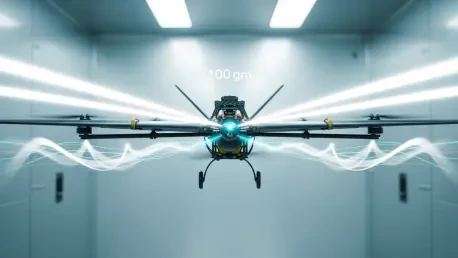
The effectiveness of this new control architecture was rigorously tested using the Flapping Nimble+ robot, a 103-gram prototype designed to simulate the flight of a large insect. During experimental trials, the team subjected the drone to various movement frequencies to observe how different settings of the disturbance observer affected its performance. They found that when the observer was set to a high-frequency response, the drone exhibited significant shaking and became nearly impossible to control due to the software fighting the wing physics. Conversely, when the response was too slow, the drone was unable to compensate for even mild air currents, drifting far off its target. The breakthrough occurred when the researchers identified the optimal bandwidth setting, which allowed the robot to achieve a level of horizontal stability that was previously thought to be impossible for a machine of its size and weight. This precision allows the drone to hover and maneuver in extremely tight spaces with much greater confidence.
The final experimental data revealed a staggering 53.1 percent reduction in position error along the primary axis of movement, paired with a 28 percent improvement in overall three-dimensional flight stability. These figures represented a significant milestone in the development of bio-inspired robotics, proving that sophisticated software could overcome the inherent physical limitations of flapping-wing mechanics. As these systems matured, they offered a clear path toward the deployment of highly resilient drones in search-and-rescue operations and complex industrial monitoring. The research successfully demonstrated that by embracing and compensating for the unique aerodynamic quirks of oscillating wings, engineers could create a new class of aerial vehicles that combined the safety of organic movement with the reliability of modern automation. Moving forward, the industry turned its attention toward integrating these control systems into mass-produced units, ensuring that the next generation of micro-drones would be capable.