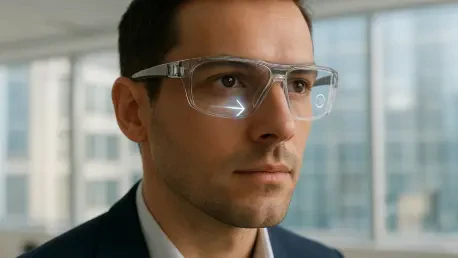

Engineers are currently redesigning optical stacks to minimize the cognitive load required to interpret small snippets of text, such as real-time translations and navigation prompts. This fundamental shift marks a departure from the historical focus on immersive, high-definition entertainment, moving instead toward a functional paradigm where digital information serves as a subtle layer over reality. The industry has recognized that for augmented reality to achieve mass adoption, the hardware must prioritize how the human eye and brain process rapid, contextual updates without experiencing fatigue or distraction. Traditional benchmarks, which once prioritized massive fields of view and extreme pixel densities at the cost of weight and heat, are being replaced by a more nuanced approach. Modern optical engineering now focuses on the “glanceability” of information, ensuring that a user can absorb a notification or a directional arrow in a fraction of a second. This evolution is driven by the integration of sophisticated artificial intelligence models that act as proactive assistants, requiring a display technology that is as unobtrusive as it is clear. As these AI agents become more integrated into daily routines, the optical system becomes the primary interface, necessitating a design that balances clarity with transparency and comfort with performance.
Market Drivers and the Shift to Everyday Use
By late 2025, AI-enabled smart glasses moved from being a niche tech demo to a dominant force in the consumer electronics market. Data indicates that these devices now account for nearly 90% of all smart-glass shipments, with waveguide technology seeing an incredible surge in popularity due to its ability to fit into standard eyewear frames. This growth proves that consumers are looking for slim, wearable eyewear that functions as an all-day digital companion rather than a bulky headset reserved for specific tasks. The transition is largely fueled by the realization that the most valuable AR applications are not those that replace the world, but those that enhance it with minimal friction. Consequently, manufacturers have pivoted away from the “all-in-one” VR/AR hybrids toward lightweight, stylish frames that users feel comfortable wearing in social and professional settings. This market pressure has forced optical engineers to solve long-standing challenges regarding the miniaturization of light engines and the efficiency of diffractive optics to meet the aesthetic demands of a broader demographic.
The shift in market demand means that the design of lenses and light engines must adapt to an “everyday assistant” model that emphasizes longevity and subtlety. Unlike previous AR devices meant for specialized industrial work or immersive gaming, modern smart glasses are designed to be worn for hours at a time, often across varying environments. This requires a fundamental rethink of the optical stack to ensure it can support hundreds of brief interactions in a wide variety of lighting conditions, from fluorescent office lighting to the harsh glare of direct afternoon sun. From 2026 to 2028, the industry is expected to see an even greater emphasis on the integration of prescriptive lenses directly into the waveguide manufacturing process, further blurring the line between traditional corrective eyewear and advanced computing platforms. By prioritizing the user’s physical appearance and the social acceptability of the device, engineering teams are ensuring that the technology becomes an invisible yet indispensable part of the modern wardrobe. This strategic pivot ensures that the focus remains on the utility provided by AI, rather than the novelty of the hardware itself.
Optimizing for Persistent Information
The way AI assistants deliver information is very different from traditional applications that a user intentionally opens and closes on a smartphone or laptop. Because AI provides real-time translations, navigation prompts, and contextual reminders based on the user’s environment, the display is active intermittently but consistently throughout the day. This requires optical systems that can “fade” information in and out smoothly without distracting the user or obstructing their primary field of vision. High-performance waveguides must now manage light in a way that allows for instantaneous activation while maintaining a “zero-state” transparency when the display is inactive. This capability is essential for safety and social interaction, as it prevents the “ghosting” effects or dark tints that characterized earlier iterations of AR hardware. Engineers are achieving this through advanced coatings and sophisticated light-engine management systems that synchronize the brightness of the digital overlay with the ambient light levels detected by external sensors, ensuring a seamless visual transition at all times.
The reliability of this information delivery is now a primary performance metric for engineers, superseding raw resolution in many design documents. A real-time translation tool is only useful if the text is just as legible in bright, direct sunlight as it is in a dimly lit room or a flickering subway car. The optical system, rather than the software itself, is often the deciding factor in whether these transitions feel natural or jarring to the person wearing the glasses. To solve this, developers are employing high-brightness microLED light engines coupled with efficiency-optimized holographic optical elements. These components work together to deliver high-contrast imagery that remains visible against complex backgrounds without requiring excessive power consumption. Moreover, the focus has shifted toward reducing the “time to click,” or the speed at which a user can focus on and understand a digital prompt. By optimizing the focal plane and minimizing chromatic aberration, engineers are ensuring that the AI’s suggestions are delivered with such clarity that the user processes them almost as instinctively as a natural thought.
The Pursuit of Readability and Physical Comfort
In the age of AI, the clarity of a single sentence of text is often more important than the visual impact of a high-resolution video or a complex 3D model. Readability has become a top priority for optical design, involving a careful balance of contrast, text definition, and precise image positioning within the user’s eye box. The goal is to minimize the effort required to understand a notification, ensuring that users do not have to squint or wait for their eyes to adjust when switching focus between the physical world and the digital layer. This involves managing the Modulation Transfer Function (MTF) of the system to ensure that small fonts remain sharp and free of the blurring often caused by internal reflections or diffraction artifacts. Furthermore, the placement of information is being algorithmically adjusted to sit within the user’s natural comfort zone, typically slightly below the primary line of sight, to prevent eye strain during prolonged use. This human-centric design philosophy ensures that the AI’s output is helpful rather than burdensome, facilitating a more natural interaction with the digital assistant.
Long-term wearability also depends heavily on the physical weight of the optical components, as even a few extra grams can cause discomfort over the course of an eight-hour day. Recent breakthroughs in materials science have led to the development of plastic waveguides, which are significantly lighter than their traditional glass counterparts and far more resistant to shattering. These plastic components are not only easier on the wearer’s bridge and ears but also meet strict safety and impact standards, making them ideal for a device intended for all-day use. Moving from 2026 to 2028, the refinement of injection-molding techniques for these high-index polymers is expected to reduce manufacturing costs while improving optical uniformity. Additionally, the reduction in weight allows for a more balanced distribution of the battery and processing units within the temples of the glasses, preventing the “front-heavy” feel that plagued early smart-glass designs. By focusing on the physical sensation of the device, engineers are removing the final barriers to making AR glasses as ubiquitous as the common smartphone.
Maintaining Transparency and System Balance
A key characteristic of AI smart glasses is their ability to complement reality rather than replace it, which requires exceptionally high optical transmittance. This design priority allows enough natural light through the lens so that the user remains fully engaged with their surroundings and can maintain eye contact with others. High transparency is vital for safety, ensuring that a digital navigation arrow or a message notification does not hide a vehicle or a pedestrian from the user’s view. Modern waveguides are now achieving transparency levels exceeding 85%, which is comparable to high-quality clear eyewear. This is achieved by using sophisticated nanostructures that specifically target the wavelengths used by the display while allowing the rest of the visible spectrum to pass through unaffected. This balance ensures that the world remains vibrant and clear, while the digital information appears as a sharp, ghostly overlay that can be ignored or engaged with at will. The social aspect of this transparency cannot be understated; it allows the user to look like they are wearing normal glasses, facilitating more natural human interactions.
Modern engineering has moved away from pursuing “hero specs” like a massive field of view at any cost, recognizing that such goals often lead to unacceptable compromises in other areas. Instead, designers are performing a delicate balancing act between weight, battery life, and image quality to create a harmonious user experience. A wider field of view might look impressive on a technical datasheet, but if it makes the glasses too heavy for long-term wear or causes the light engine to overheat the frame, it ruins the practical utility of an AI-centric device. Consequently, many leading manufacturers are opting for a more focused field of view that covers the central 30 to 40 degrees, which is sufficient for displaying text and simple icons while keeping the overall system efficient. This disciplined approach to design ensures that every milliwatt of power is used effectively, extending the device’s battery life to last a full workday on a single charge. By optimizing for the specific needs of AI interactions rather than general-purpose immersion, engineers have created a specialized class of hardware that excels in the environments where it is most needed.
New Methodologies for Human-Centric Optics
As the goals of the industry evolve, the ways success is measured are also undergoing a significant transformation. Traditional lab tests, such as measuring peak luminance in a dark room, are being replaced by more advanced evaluation techniques that focus on human perception in messy, real-world environments. New standards are being developed through collaborations between industry leaders and academic researchers to study how the human eye responds to repeated interactions with virtual content. These studies look at factors like vergence-accommodation conflict and the speed at which a user can switch their attention between different depths. By incorporating eye-tracking data and pupillometry into the testing phase, engineers can gain a better understanding of the cognitive load imposed by different display configurations. This data-driven approach allows for the creation of optical systems that are “vision-aware,” adjusting their output based on the user’s physiological state and environmental context. These new benchmarks ensure that the next generation of AR hardware is built from the ground up to support the complexities of human vision.
Ultimately, the optical stack serves as the essential bridge between artificial intelligence and human perception, a role that defined the engineering milestones of the mid-2020s. No matter how smart a software model becomes, its success depends entirely on the hardware that delivers its data to the human eye in a clear, comfortable, and safe manner. For AI to become a truly seamless part of daily life, optical engineering had to prioritize the subtle needs of the human visual system over the pursuit of raw power. The transition established a new baseline for the industry, where the most successful devices were those that disappeared into the user’s lifestyle while providing a constant, helpful presence. Engineers prioritized the reduction of optical artifacts and the improvement of thermal management, which allowed these devices to move from experimental labs to the streets. As a result, the foundation for a new era of personal computing was laid, one where the hardware acts as a transparent window to a more informed and connected reality, setting a precedent for all future developments in wearable technology.