
Mastering the mass production of specialized augmented reality optics provides a strategic advantage in adjacent high-growth markets like autonomous vehicle LiDAR and advanced medical imaging tools. The global competition to bring augmented reality smart glasses to the masses has long been framed as a battle of visionary design, yet the current landscape suggests a pivot toward industrial capability. Tech giants have spent years and billions of dollars refining display resolutions, expanding fields of view, and embedding sophisticated artificial intelligence into sleek frames. However, the focus is beginning to shift from what can be built in a laboratory to what can be scaled efficiently in a factory. The ultimate leader in this space will likely not be the company with the most impressive prototype, but the one that masters the transition to high-volume manufacturing. This evolution represents a fundamental change in how the industry defines innovation as consumer demand for wearable tech grows.
Economic Benchmarks: The Shift from Laboratory to Factory
Achieving a specific economic benchmark is essential for triggering mass-market growth in the wearable display sector. Currently, the high cost of display modules acts as a primary barrier to entry, with industry experts suggesting that each module must cost less than $100 to support sales volumes exceeding 100 million units globally. Achieving this price point without sacrificing performance or durability is the central challenge facing contemporary engineers and supply chain managers. The struggle to hit this target highlights a significant gap between high-end laboratory optics and the brutal cost requirements of the consumer electronics market. When costs remain high, the technology stays trapped in a niche professional bracket, failing to achieve the ubiquity necessary for a platform shift. Therefore, companies are prioritizing yield optimization over raw specification increases to ensure that the hardware is affordable for a broader demographic beyond early adopters.
To understand where the AR industry is headed, one can look at the history of semiconductor fabrication as a reliable blueprint for industrial maturity. In its early days, the semiconductor world was driven by design breakthroughs and transistor counts, but as the market matured, dominance was decided by manufacturing excellence rather than just theoretical capability. The companies that perfected the fabrication process to ensure high yields and consistent output became the definitive leaders of the digital age. The optical industry is now entering a similar phase of maturity, where the ability to build a reliable production framework is arguably more valuable than the design itself. Success in the coming years will depend on overcoming the “valley of death” between a functional research model and a consumer-ready product that can be manufactured at scale. This transition requires a shift in mindset from traditional optics to wafer-based production cycles that mimic computer chips.
Scalable Optical Fabrication: Nanoimprinting and Wafer Technology
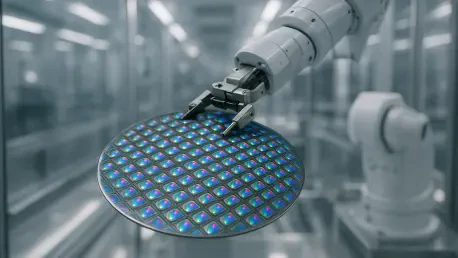
Traditional methods of shaping glass or molding polymers are proving insufficient for the complex needs of modern augmented reality hardware. While glass is durable, it is often too heavy and slow to process for lightweight glasses, and polymers frequently suffer from reliability issues in diverse environmental conditions. The emerging solution lies in nanoimprinted wafer-level optics, a technique that leverages the precision of semiconductor manufacturing for optical components. This method allows manufacturers to create thousands of optical structures simultaneously on a single wafer, significantly increasing throughput and reducing unit costs while maintaining the nanometer-scale precision required for high-end waveguides. By utilizing these advanced fabrication processes, companies can minimize the manual labor traditionally associated with lens assembly. This automation is key to ensuring that every pair of glasses meets rigorous quality standards, thereby reducing the rate of defects that plagued earlier iterations.
These advancements are further supported by the use of metaoptics, which utilize the physics of light diffraction rather than traditional refraction to manipulate visual data. Unlike thick glass lenses that bend light by passing it through a dense medium, metaoptics use nano-scale structures to achieve the same optical results with significantly less mass and volume. This shift allows for a simplified hardware system with fewer moving parts and components, which in turn reduces the risk of mechanical failure and makes the final product much more comfortable for the user to wear all day. The integration of flat optics into the frame design solves the aesthetic problem that has historically hindered consumer adoption. By replacing bulky curved lenses with thin, high-performance surfaces, manufacturers can create devices that look indistinguishable from standard eyewear. This technological leap forward ensures that the physical footprint of the hardware no longer compromises the wearer’s comfort.
Engineering for Resilience: Material Science and Reliability
Reliability is a critical factor for any consumer device, and augmented reality glasses are no exception to this rule of market success. For these devices to succeed, they must function perfectly in various climates and conditions over several years of daily operation. This is where material science becomes a major competitive advantage for firms willing to invest in long-term durability research. By moving away from fragile plastics and toward proprietary, all-inorganic materials, companies can ensure their optical components do not degrade or discolor over time. Building this level of environmental stability is a prerequisite for earning consumer trust and maintaining brand longevity in an increasingly crowded and competitive global market. Devices that fail after exposure to heat, humidity, or accidental drops will quickly lead to brand erosion. Consequently, the focus on manufacturing excellence includes rigorous stress testing and the development of robust protective coatings that safeguard sensitive optical paths.
The implications of mastering these production techniques extend far beyond the world of smart glasses and consumer entertainment. The same optical platforms being developed for augmented reality are highly relevant to other high-growth sectors, including autonomous vehicles and aerospace defense. Companies that solve the manufacturing puzzle for AR optics will find themselves positioned to dominate multiple industries simultaneously by offering specialized sensors and display units. This cross-sector potential provides a stabilized business model, allowing companies to thrive even if the consumer AR market takes longer to mature than initial forecasts suggested. For instance, the high-precision waveguides used in eyewear are being adapted for head-up displays in cars and advanced surgical overlays in the medical field. By diversifying the application of these manufacturing processes, organizations can amortize the massive research and development costs over a wider range of products, ensuring financial stability.
Strategic Product Lifecycle: The Future of Industrial Integration
The final hurdle for the industry is a strategic one, requiring companies to stop treating manufacturing as an afterthought in the product development cycle. For a product to be truly successful, the ability to produce it at scale must be integrated into the initial design phase rather than addressed after the engineering is complete. This philosophy, known as Design for Manufacturing, ensures that every component is optimized for assembly efficiency from the very beginning. The next decade will prove that the most valuable intellectual property is not the theoretical design of the lens, but the specialized, proprietary process used to create it. The winners of the AR race will be those who can transform a revolutionary high-tech concept into a reliable, ubiquitous tool for millions of people around the world. This requires a deep integration between optical designers and factory floor engineers to identify potential bottlenecks before they impact production timelines or costs.
In summary, the industry recognized that the transition from prototypes to mass production required a total realignment of corporate priorities. Leaders shifted their focus toward establishing vertically integrated supply chains that prioritized high-yield fabrication over marginal performance gains. Stakeholders invested heavily in automated inspection systems and inorganic material development to ensure long-term device stability. Successful firms implemented modular design architectures that allowed for rapid scaling across different product tiers, from entry-level wearables to professional-grade surgical tools. By treating the manufacturing facility as the primary site of innovation, the industry paved the way for the broad adoption of augmented reality. Strategies involved early collaboration with semiconductor foundries and specialized glass manufacturers to secure the necessary capacity for global distribution. This proactive approach ensured that the technological promise of augmented reality finally met the marketplace.