
The rapid convergence of sophisticated sensor arrays and localized neural processing has fundamentally altered the baseline expectations for industrial sanitation equipment across the globe. As commercial spaces become more complex and labor markets fluctuate, the traditional model of manual floor maintenance is being replaced by systems that do not merely follow paths but understand their environments. This shift is exemplified by the European debut of the PUDU BG1 Series, an AI-native large scrubber-dryer robot designed to handle the rigorous demands of high-traffic facilities. By moving away from rigid, pre-programmed automation toward a more fluid and responsive intelligence, the industry is witnessing a transition where the machine takes on the role of a sentient operator. The partnership between Pudu Robotics and the prominent Dutch cleaning service provider Gom Schoonhouden, facilitated by regional partner Fulin Robot Technologie, signals a new era where operational outcomes are prioritized over simple task execution.
Technological Innovation and AI Integration
AI-Native Architecture: Moving Beyond Rigid Programming
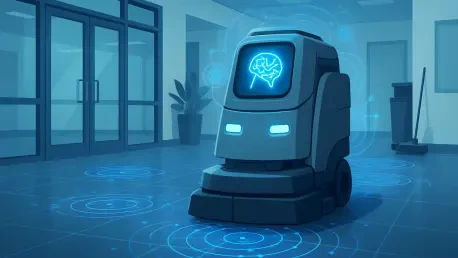
The core differentiator in the latest generation of service robotics lies in the transition from traditional automation to an AI-native architectural framework. Legacy systems often relied on fixed maps and strict schedules, which made them prone to failure when faced with unexpected obstacles or changes in floor layouts. In contrast, the BG1 Series utilizes a continuous operational loop of perception, decision-making, and execution that allows it to interpret visual and spatial data in real-time. This architectural shift means the robot is not just reacting to its surroundings but is proactively managing the cleaning process based on the specific conditions it encounters. For facility managers, this translates to a significant reduction in the time spent troubleshooting robotic errors or manually re-routing machines. The ability of the software to evolve and adapt within its environment ensures that the cleaning quality remains consistent, regardless of how busy or cluttered a commercial space may become during a standard shift.
Central to this technological leap is the proprietary AI Magic Cleaning system, which empowers the robot to detect messes before it even reaches them. Once a spill or debris is identified, the system automatically adjusts critical operational parameters, such as chemical distribution levels and brush pressure, to ensure a thorough clean in a single pass. This outcome-driven intelligence effectively minimizes manual intervention, allowing human staff to focus on more complex tasks that require personal attention. By integrating these decision-making capabilities directly into the hardware’s operating system, the machine can handle varied surfaces and soil levels with a precision that was previously unattainable. This transition from basic task-based execution to a sophisticated, autonomous model marks a definitive milestone in the commercial cleaning sector. It establishes a benchmark for how large-scale service providers can leverage intelligent systems to achieve superior consistency and scalability in an increasingly competitive and demanding global market.
Functional Advancements: Eliminating Operational Blind Spots
One of the most persistent challenges in robotic cleaning has been the inability of machines to reach the very edges of a room or navigate around complex shelving. The BG1 Series addresses this limitation through an innovative, extendable edge cleaning mechanism that allows the brushes to work flush against walls and permanent fixtures. This feature eliminates the “blind spots” that typically require manual follow-up by human janitorial staff, thereby streamlining the entire maintenance workflow. Furthermore, the integration of a dual-function sweep-and-scrub system allows the robot to handle both dry debris and wet scrubbing simultaneously. By combining these two essential functions into a single pass, the machine significantly reduces redundant operations and maximizes the productivity of each battery cycle. This is particularly vital in high-traffic commercial environments where the window for deep cleaning is often narrow and the demand for hygiene is exceptionally high.
Beyond simple mechanical improvements, the hardware design is optimized to support the software’s advanced analytical capabilities, ensuring that every movement is as efficient as possible. The robot’s ability to collect and process data while in motion allows it to optimize its pathing on the fly, reducing energy consumption and wear on components. This synergy between physical engineering and digital intelligence represents a holistic approach to facility management that goes beyond mere floor scrubbing. As these machines become more integrated into the daily operations of shopping malls, hospitals, and airports, their ability to perform with minimal supervision becomes a critical asset. The reduction in operational downtime and the increase in square footage covered per hour provide a clear economic incentive for the adoption of such advanced technology. This progress reflects a broader industry trend where the focus is no longer just on replacing labor, but on enhancing the overall quality and reliability of the sanitation infrastructure.
Market Context and Strategic Industry Trends
Global Growth: The Ascendance of Intelligent Solutions
The deployment of AI-native robotics is not an isolated event but part of a massive shift in the global robotics sector, where cleaning has emerged as a dominant growth engine. Pudu Robotics has solidified its position at the forefront of this movement, capturing a 23 percent global market share and reporting a 100 percent year-over-year revenue growth as of early 2026. With over 120,000 units shipped across various international markets, the company has demonstrated that the demand for autonomous cleaning solutions is both vast and accelerating. Notably, cleaning robotics now accounts for more than 70 percent of the firm’s total revenue, underscoring the vital role these machines play in modern commercial operations. The successful entry of previous models like the PUDU CC1 into North American and European markets paved the way for the more specialized and powerful BG1 Series, showing that the market is ready for higher levels of autonomy.
This growth is fueled by a strategic realization among service providers that mechanical efficiency alone is no longer enough to meet modern standards. The collaboration between technology developers and established service firms like Gom Schoonhouden highlights a commitment to integrating intelligence into every layer of the cleaning process. As these partnerships mature, they provide the necessary real-world data to refine AI models further, creating a virtuous cycle of improvement. The move toward AI-native infrastructure allows large-scale service providers to offer more reliable and transparent results to their clients, backed by verifiable data and autonomous performance metrics. This environment fosters a new operational paradigm where the value of a cleaning service is measured by its ability to maintain high standards through the intelligent application of technology. Consequently, the industry is moving toward a future where autonomous systems are the primary drivers of sanitation, supported by a workforce that manages and optimizes these digital assets.
Strategic Vision: Benchmarks for Professional Scalability
The consensus among industry leaders at the conclusion of these initial European deployments was that the fundamental definition of commercial cleaning had been successfully rewritten. Innovation was no longer viewed strictly through the lens of mechanical power or water capacity, but rather through the successful implementation of AI-native infrastructure. This approach allowed machines to move beyond simple execution toward a true understanding of the environment, facilitating autonomous decision-making that mirrored human logic. By establishing this new operational paradigm, the partnership between technology providers and facility managers set a high benchmark for the industry. Large-scale service providers realized that leveraging these intelligent systems was the most effective way to achieve the consistency and scalability required in the modern global market. The transition to these advanced systems proved to be a necessary step for organizations looking to future-proof their operations against labor shortages and rising quality expectations.
Moving forward, the focus shifted toward the long-term integration of these robots into broader building management systems. Facility managers were encouraged to view AI-native robots not as standalone tools, but as interconnected nodes within a smart building ecosystem. This perspective allowed for even greater efficiencies, as robots shared data with lighting, HVAC, and security systems to optimize their schedules and performance. The data gathered during these initial phases provided actionable insights that led to more precise resource allocation and improved environmental sustainability. Organizations that adopted these technologies early found themselves better positioned to adapt to new regulatory standards and evolving client demands. The successful rollout of the BG1 Series served as a practical blueprint for how to balance cutting-edge technology with the practical realities of commercial maintenance. Ultimately, the industry embraced a model where intelligence and automation worked in tandem to provide a safer, cleaner, and more efficient environment for everyone.