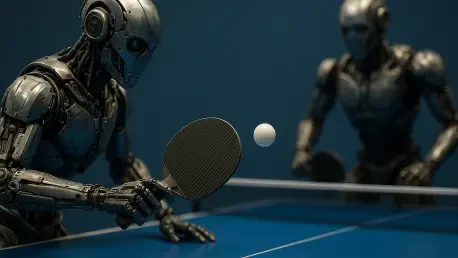

A physics simulator calibrated with real-world ball bounce measurements was used to train a seven-joint racket-arm refinement policy for precise ball trajectory adjustments. This breakthrough technology represents a significant leap in the field of collaborative humanoid robotics, specifically targeting the high-speed, high-precision environment of table tennis doubles. Developed by a cross-institutional team from the University of Hong Kong, NVIDIA, and the Shanghai Innovation Institute, the PingpongDuo framework solves the complex problem of two humanoid robots sharing a constrained physical space while following strict alternating-strike rules. Unlike single-agent systems, this setup requires a deep understanding of spatial temporal dynamics to prevent collisions during rapid-fire rallies. The system manages the dual challenge of individual mechanical precision and collective tactical positioning, ensuring that each robot can move into the strike zone without obstructing its partner’s trajectory or recovery phase. This evolution in robotic dexterity suggests that humanoid machines are moving beyond isolated laboratory tasks and toward sophisticated, shared physical activities that mirror human athletic cooperation and spatial awareness.
Hierarchical Architecture: Coordinating Team and Individual Logic
The technical core of this innovation lies in a hierarchical control structure that separates high-level team strategy from low-level individual execution. At the highest level, a specialized cooperative planner determines the ideal placement for both robots based on the incoming ball’s trajectory. To navigate the risks inherent in two large machines moving at high speeds within centimeters of each other, the system employs a learned risk estimator. This component evaluates thousands of potential motion paths in real-time, identifying configurations that might lead to a collision between the robots’ limbs or bodies. A dedicated safety filter then intervenes when a high-risk scenario is detected, dynamically adjusting the movement of the non-striking robot. By prioritizing the strike-authorized unit, the filter ensures the return is successful while the partner clears the area. This logic allows for seamless transitions and maintains the flow of the game without mechanical failure.
Individual robot performance is driven by separate artificial intelligence policies that manage footwork and racket manipulation independently. The movement policy is particularly sophisticated, having been trained on a diverse library of approximately two hundred distinct footwork sequences modeled after professional human doubles players. This allows the humanoid units to transition fluidly between striking, clearing the hitting zone, and recovering a defensive stance. Using the Unitree G1 humanoid platform, the framework demonstrates the ability to execute complex 2.15-meter clearance cycles in just 2.4 seconds. These movements involve high-velocity lateral shifts reaching peak speeds of 2.23 meters per second, a feat that requires immense torque and balance control. Such agility ensures that the robots remain ready for the next strike in an alternating sequence, mimicking the rhythm and physical demands of an actual competitive match while keeping the center of gravity stable during rapid accelerations.
Empirical Performance: Validating Collaborative Humanoid Efficiency
Empirical testing of the PingpongDuo framework revealed substantial improvements over existing state-of-the-art robotic systems. In simulated environments, the system achieved a 13.2 percent higher success rate in ball returns compared to previous multi-agent coordination models. These results translated effectively to real-world hardware, where two humanoid robots were able to sustain rallies exceeding ten consecutive alternating strikes. This level of consistency is largely attributed to the racket-arm refinement policy, which meticulously adjusts seven different arm joints to compensate for slight errors in the robot’s overall body position. By focusing on the final moments of contact, the refinement policy ensures that the ball is returned with the correct velocity and angle, even when the robot is still moving into place. This secondary layer of control compensates for the inherent latency and mechanical inaccuracies often found in mobile humanoid platforms, creating a robust strike mechanism.
The successful implementation of the PingpongDuo system demonstrated that humanoid robots could collaborate in high-pressure, confined environments with remarkable efficiency. While the research proved the viability of multi-robot coordination, several opportunities for advancement were identified during the testing phase. Future iterations of this technology began to incorporate onboard perception systems to replace external motion-capture setups, allowing for greater autonomy in diverse settings. Researchers also recognized the need to account for ball spin, which remains a significant hurdle in professional-level play. Developing sophisticated spin estimation techniques and autonomous offensive strategies became a primary focus for subsequent development cycles. Ultimately, this framework provided a foundational blueprint for how humanoid machines could navigate shared physical spaces while performing synchronized, high-speed tasks. The project established a clear path toward more complex robotic interactions in industrial and recreational applications alike.