
The rapid convergence of high-speed telecommunications, edge computing, and modular robotics has fundamentally altered the landscape of modern security operations across the globe. As nations grapple with the high political and social costs of human casualties, the deployment of autonomous systems has transitioned from a supplemental capability to a primary strategic necessity. This shift is most visible in regions where high-intensity conflict and internal stability are paramount concerns, driving a race to replace traditional infantry and police units with hardened machines. By moving away from the physical and psychological limitations inherent in human personnel, state actors are now prioritizing a technological industrial base that can sustain a high volume of robotic output. The current environment reflects a move toward a doctrine where tactical superiority is measured not by the size of an army, but by the sophistication and scale of its automated platforms, marking a permanent departure from 20th-century warfare.
The Mechanization of Ground Combat and Domestic Order
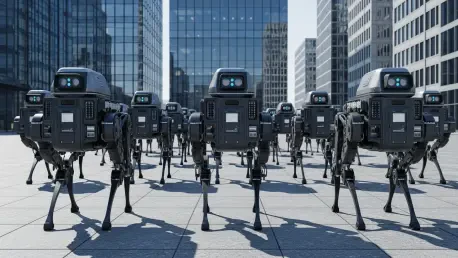
Ukraine has moved aggressively to automate its defense by committing to the deployment of 25,000 ground robots within the first half of 2026 to secure its borders. This massive logistical undertaking aims to automate 100% of frontline logistics, focusing on high-risk tasks such as casualty evacuation and the delivery of heavy ammunition under active fire. A robust domestic ecosystem of more than 280 specialized companies has emerged to meet this demand, producing diverse robotic platforms designed for everything from seizing enemy trenches to deploying heavy weaponry like machine guns and rocket launchers. These machines are increasingly viewed as more reliable than biological soldiers because they do not suffer from exhaustion, fear, or the trauma associated with intense combat. The strategic intent is to saturate the battlefield with cost-effective, replaceable units that preserve human life while maintaining a continuous and lethal presence in contested zones, effectively turning the front into a fully automated theater.
Simultaneously, the People’s Armed Police in China has pioneered the use of autonomous “riot squads” to manage domestic unrest and civil disturbances through coordinated machine intelligence. These units operate under a central artificial intelligence command system that synchronizes reconnaissance drones, robot dogs, and armored vehicles to isolate and disperse large gatherings without direct human intervention. Utilizing advanced pattern recognition, these squads can identify specific individuals within a crowd to execute targeted “kettling” maneuvers with robotic barriers, preventing the escalation of physical confrontations. Equipped with non-lethal tools like tasers and capture nets, these machines provide a precise and tireless enforcement mechanism that minimizes the risk of injury to officers. The training environments for these squads often simulate complex urban settings, indicating a high level of preparation for specific geopolitical contingencies and the maintenance of social stability through cold, algorithmic precision.
The transition toward roboticized frontlines was solidified as global powers successfully integrated artificial intelligence into the core of their tactical decision-making frameworks. Decision-makers learned that the primary challenge was no longer the creation of individual machines, but the orchestration of vast swarms that could react faster than any human commander. To navigate this new reality, organizations had to prioritize the development of secure, localized mesh networks that could withstand electronic warfare while maintaining machine-to-machine communication. Future security strategies should focus on the standardization of interchangeable parts and open-source software architectures to ensure that robotic fleets can be repaired and updated in the field without relying on centralized factories. By establishing rigorous ethical oversight protocols for remote monitoring, leaders ensured that humans remained responsible for the final authorization of force. This era proved that technological endurance and manufacturing speed had become the ultimate deciders of national security.