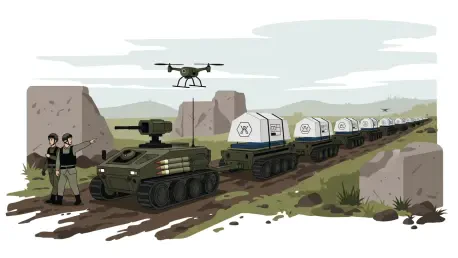

Outnumbered infantry squads once shouldered the most dangerous work at the front, but a Ukrainian assault unit recently flipped that script by capturing enemy soldiers with only unmanned ground systems and drones, no human captors on site and not a shot fired, turning an experiment into doctrine. That unit, NC13 of the Third Separate Assault Brigade, has since made robot-led missions routine, reflecting a broader shift to offset chronic manpower gaps with machines. The government linked this pivot to measurable effects: more than 22,000 unmanned missions in three months reportedly saved as many lives by sending robots where soldiers would have died, while in March alone ground platforms executed over 9,000 logistics and medical evacuations. Commanders noted one armed ground robot stalled a Russian push for 45 days with scant maintenance, underscoring persistence, low signature, and cost discipline. The message was blunt: scale wins, and scale starts with logistics, not science projects.
From Proof to Scale: How Robots Changed the Front
Building on this foundation, Ukraine moved from ad hoc tinkering to industrialized procurement. Under Defense Minister Mykhailo Fedorov, the plan set out to buy 25,000 ground robots in the first half of the year—more than double last year’s fielding—anchored by 19 contracts worth 11 billion hryvnias. The domestic ecosystem now counted over 280 companies with roughly 550 active solutions, a pipeline fostered by the Brave1 cluster, which had already issued 175 grants to speed trials and certification. Platforms like Ratel and TerMIT hauled ammunition under fire, Ardal and Rys shuttled casualties through rubble, and Zmiy, Protector, and Volia carried modular payloads for breaching or surveillance. The Bizon-L entered service with a NATO-compatible classification, a signal that standards, data formats, and spares lines were being aligned with allied doctrine. Ukrainian officers stressed the same theme: robots would not hold ground alone, but they could keep humans alive long enough to counterattack.
This approach naturally led to new tactics and command rhythms. NC13 articulated a target to replace up to 30% of frontline infantry tasks with robotic systems, prioritizing logistics-first automation and force protection over autonomous occupation of terrain. Analysts also weighed in. RUSI’s Robert Tollast cautioned that ground drones might struggle to seize or hold positions unaided, but highlighted decisive advantages in resupply, casualty evacuation, and selective combat—missions now central to NC13 playbooks. The Institute for the Study of War assessed that Ukraine’s drone edge helped stall Russian advances and opened windows for counterattacks, while warning that Russia was adapting and pressing its own programs. Ukrainian commanders echoed that edge retention hinged on scaling rather than inventing first; the unit with more reliable machines, spares, and trained operators would dictate tempo. Taken together, the war’s ground truth favored repeatable, repairable, and standardized robotics over one-off marvels.
Staying Ahead at Scale: What Must Happen Next
A durable lead required choices that translated prototypes into sustained combat power, and several actions stood out. First, logistics robots should stay the main effort, backed by forward repair nodes, shared batteries, and swappable drive modules that kept Ratel-, Volia-, and Protector-class vehicles in the fight without depot delays. Second, control software needed to converge on common APIs across families like TerMIT, Ardal, and Bizon-L, allowing platoon leaders to task any platform through a unified interface and to fight through jamming with layered autonomy. Third, electronic warfare resilience—shielded links, frequency agility, and dead-reckoning fallback—had to be baked into every tranche, not patched later. Training pipelines for NC13-style units should expand to certify operators, maintainers, and data analysts together, turning mission logs into rapid upgrades. Finally, NATO-facing standardization should deepen around Bizon-L’s model so allied munitions, spares, and doctrine could plug in without friction. If executed, these steps would have preserved saved lives, sustained tempo, and kept the scaling advantage decisively in Ukraine’s column.