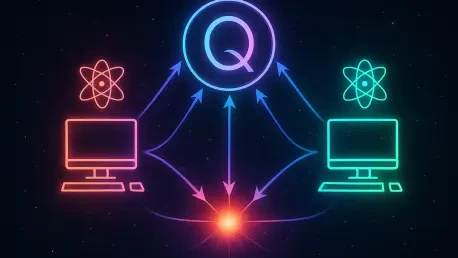

Frequency-bin encoding offers a scalable solution for multiparty communication because it allows for the multiplexing of orthogonal modes within a single-mode fiber. This technical leap, pioneered by researchers at Purdue University and Aliro Technologies, signifies a transformative shift in the architecture of quantum communication networks. For years, the industry was confined to two-party exchanges, yet this new demonstration successfully facilitates a secure three-party secret sharing protocol involving participants traditionally designated as Alice, Bob, and Sara. By moving beyond the limitations of polarization or time-bin encoding, the team utilized the inherent properties of light frequencies to ensure data integrity across standard telecommunications infrastructure. This achievement indicates that the implementation of a quantum internet may not require a radical overhaul of physical hardware but can instead utilize the fiber optic backbone already in place today. The success of this experiment establishes a foundation for complex network topologies that were previously considered theoretically possible but practically infeasible.
Robust Technical Advantages: The Shift to Frequency-Bin Encoding
The transition toward frequency-bin encoding is primarily driven by the need for stability in real-world environments where temperature fluctuations and physical vibrations can easily disrupt more delicate quantum states. Traditional methods like polarization encoding often require meticulous alignment and complex compensation systems to maintain the phase relationship between photons, which becomes increasingly difficult as more nodes are added to the network. In contrast, frequency-bin systems utilize specific “bins” of light frequencies to carry information, making them significantly more resilient to the typical noise found in commercial fiber networks. By employing programmable spectral filters and electro-optic modulators, the researchers managed to manipulate these frequency states with a high degree of precision without the need for cumbersome sub-wavelength interferometric stabilization. This technical resilience is a cornerstone for transitioning quantum protocols from controlled laboratory settings into the chaotic reality of global telecom networks.
Beyond its inherent robustness, the integration of frequency-bin encoding with existing hardware highlights a clear path toward scalable multiparty systems. The telecommunications industry has spent decades refining technologies like dense wavelength-division multiplexing, which naturally aligns with the frequency-based approach used in this quantum secret sharing breakthrough. Because the equipment needed to filter and route these frequency bins is already part of the standard industrial toolkit, the cost and complexity of deploying such networks are greatly reduced compared to more exotic quantum alternatives. This compatibility ensures that as more participants—beyond the initial three—are added to a network, the overhead does not grow exponentially. The ability to multiplex orthogonal modes within a single fiber allows for a dense packing of information, effectively paving the way for a multiuser environment where secure keys can be distributed simultaneously across city-wide or even nationwide fiber optic infrastructure.
High-Speed Performance: State Switching and Hardware Dynamics
A hallmark of this experiment is the remarkable speed at which the quantum states and measurement bases are switched, reaching a rate of 20 MHz. This high-frequency operation is enabled by advanced microwave processing and analog phase shifters that operate on nanosecond timescales, providing a level of agility that was previously unattainable with older technology. In previous iterations of quantum communication, researchers often relied on liquid-crystal-on-silicon pulse shapers, which were limited to millisecond switching speeds and were thus insufficient for high-throughput secure protocols. The ability to switch bases pseudorandomly at such high speeds is not merely a benchmark for performance but a fundamental requirement for maintaining security in a dynamic environment. By rapidly changing the measurement criteria, the system stays one step ahead of potential interception attempts, ensuring that any eavesdropper attempting to monitor the traffic would be unable to keep pace with the shifting parameters of the quantum exchange.
While the 20 MHz switching rate represents a massive improvement over traditional methods, it also brings the system close to the physical limitations of current detection hardware. The superconducting nanowire single-photon detectors used in the Purdue and Aliro study feature a 25-nanosecond recovery period, commonly known as dead time, which currently sets an upper bound on how quickly individual photons can be processed. However, the researchers emphasized that as detector technology continues its rapid advancement, with some specialized units already reaching recovery times as low as 4 nanoseconds, the potential for even faster communication speeds is within reach. This suggests that the bottleneck is no longer the protocol or the encoding method itself, but rather the cooling and timing efficiency of the single-photon sensors. As these components mature from 2026 to 2028, the industry can expect a direct translation of hardware improvements into higher bandwidth for quantum secret sharing, matching the speeds required for high-definition data streaming.
Quantifying Security: Metrics and Protocol Accuracy
Security in a quantum network is quantified by the Quantum Bit Error Rate, a metric that serves as a pulse check for the integrity of data transmission. In this three-party demonstration, the team consistently achieved a rate below 4.5% across all configurations, which is significantly lower than the 11% theoretical limit required to establish a secure and positive key. This low error rate is a testament to the precision of frequency-bin encoding and the high-speed synchronization hardware employed during the tests. Furthermore, the three-party correlations reached levels exceeding 0.91, indicating that the quantum states shared between Alice, Bob, and Sara were nearly identical even under the stress of active switching. These statistics are crucial for real-world adoption, as they provide the mathematical certainty needed for government and financial institutions to trust quantum networks with their most sensitive information. The consistency of these results across fiber lengths proves the system is not only secure but also reliable.
The underlying security architecture of the protocol relies on the complementarity principle, a fundamental concept in quantum mechanics where the act of measurement influences the state of the system. In this specific three-party secret sharing scheme, the protocol is designed so that no single participant can reconstruct the full secret in isolation. For instance, Alice’s initial measurements provide zero actionable data regarding Sara’s private bit until Bob contributes his findings to the collective group. This interdependence creates a “security by design” environment where collaboration is a prerequisite for access, effectively neutralizing the threat of an inside actor or an external interceptor. If an unauthorized third party attempts to observe the quantum states as they travel through the fiber, the inherent sensitivity of the photons will cause a measurable spike in the error rate. This alert mechanism allows the legitimate users to immediately identify a breach and discard the compromised data, ensuring that the secret remains confidential.
Network Scalability: Infrastructure Integration Techniques
Expanding quantum secret sharing from a laboratory bench to a city-wide scale requires overcoming the challenges of signal synchronization over kilometers of fiber. To address this, the research team utilized Radio Frequency over Fiber techniques to maintain timing precision across long distances, ensuring that all participants remain in perfect temporal alignment. During specialized testing involving a 5.5-kilometer fiber spool, the researchers observed a phase shift of less than 0.5 picoseconds over a 30-minute window, a level of stability that is more than sufficient for maintaining quantum coherence. This suggests that the infrastructure required to synchronize metropolitan quantum nodes is already available and can be integrated with existing high-speed network protocols. The ability to maintain such tight timing over significant distances is the bridge that connects experimental physics to practical network engineering, allowing for the deployment of secure quantum links using the fibers that carry internet traffic.
A major advantage of this approach is its fundamental compatibility with the existing telecommunications ecosystem, which minimizes the need for specialized and expensive new installations. By leveraging standard hardware such as Swabian time taggers and Hittite signal generators, the researchers established a common frequency and phase reference that is easily replicable in commercial environments. This reliance on off-the-shelf components, combined with the ability to multiplex multiple orthogonal modes within a single fiber, makes the system inherently scalable. Adding more users to the secret sharing group—moving from three parties to many more—does not require a linear increase in physical hardware, as frequency-bin encoding can accommodate a large number of independent channels. This modularity is essential for the growth of a future quantum internet, as it allows network operators to expand their services incrementally as demand for high-security communication grows. The fusion of traditional networking with quantum protocols provides a realistic roadmap.
Strategic Milestones: The Path to Global Quantum Connectivity
While the demonstration marked a definitive breakthrough, the path toward a fully operational commercial system involved several critical developmental stages. Engineers and scientists recognized that the next phase of progress required the automation of raw-key generation and basis sifting to streamline the distillation of quantum data. This transition was supported by the implementation of sophisticated error-correction algorithms that effectively neutralized the minor noise present in high-speed transmissions. By integrating these software-level protocols directly into the hardware controllers, researchers simplified the user experience, moving closer to a “turnkey” solution for secure communication. The maturity of these post-processing techniques allowed the system to maintain its high security profile while handling the massive volumes of data required for modern enterprise applications. This evolution from a laboratory success to a functional prototype demonstrated that the mathematical foundations of the protocol were ready for integration into more demanding network environments.
Looking ahead, the focus shifted toward the deployment of distributed synchronization across physically remote geographical nodes, moving away from a single local reference source. This transition was essential for building a truly global quantum internet that could operate across continents and oceans. The reconfigurable nature of frequency-bin encoding proved to be uniquely suited for these advancements, as it allowed for the seamless addition of new nodes without disrupting existing connections. As detector technology continued to evolve from 2026 into the late 2020s, the speed and efficiency of these networks surpassed initial expectations, creating a new standard for secure multiparty interactions. The integration of high-speed microwave electronics with photonics ultimately provided the blueprint for a scalable, resilient quantum network that successfully adapted to the needs of modern global infrastructure. By proving that three parties could share a secret with unprecedented accuracy, the team established a new benchmark for digital privacy.