
Zero-velocity updates act as a crucial braking mechanism for filters, preventing the integration of noise during the brief pauses between steps. In the current technological landscape of 2026, the convergence of neuroscience and mechanical engineering has given rise to sophisticated neurorobotics, where the primary goal is to replicate the agility and sensory processing of living organisms. A significant hurdle in this field is proprioception, the ability of a robot to perceive its own position and movement within a space without the assistance of external systems like GPS or motion-capture arrays. For small-legged systems, this challenge is compounded by high sensor noise and complex body dynamics. Recent advancements in sensor fusion and bioinspired design are providing new pathways to overcome these obstacles, allowing minimalist platforms to navigate indoor environments with unprecedented accuracy. By focusing on internal models rather than external aids, researchers are developing robots that mirror the resourcefulness of biological creatures, ensuring they can function in diverse settings where traditional navigation data might be unavailable or unreliable.
Foundations of Bioinspired Robotic Locomotion
The development of modern robotic navigation is deeply rooted in the study of vertebrate biology, specifically the vestibular system found in most mammals. In animals, specialized organs such as the otoliths and semicircular canals detect linear acceleration and angular velocity, providing the foundation for balance and coordinated movement. Robotics researchers mirror this biological apparatus through the implementation of inertial navigation systems, which utilize accelerometers and gyroscopes to estimate velocity and orientation. However, transitioning from a biological blueprint to a mechanical implementation introduces the persistent problem of unbounded drift. Because position is calculated by integrating acceleration twice over time, even the smallest sensor bias is amplified quadratically. In the context of small robots that experience significant vibrations and sudden movements during their gait, these errors can render raw inertial data useless within seconds, necessitating a more robust filtering approach that mimics the error-correction capabilities of a biological brain.
Beyond the fundamental physics of motion sensing, the mechanical design of a platform plays a critical role in how sensory data is interpreted and utilized. For a small robot to move effectively, its skeletal structure and actuation must provide consistent feedback that the software can translate into spatial awareness. This relationship between physical form and computational processing is at the heart of neurorobotics. High-performance systems in 2026 are increasingly moving away from brute-force sensing and toward refined internal models that predict how the body should behave based on its unique physical proportions. By aligning the mechanical constraints of the robot with the predictive capabilities of the navigation algorithm, engineers can minimize the discrepancy between the commanded movement and the actual displacement. This synergy allows for more fluid locomotion and provides a more stable baseline for the sensor fusion algorithms that must reconcile noisy inertial readings with the reality of the robot’s physical environment.
Biological Inspiration and Inertial Sensing
The reliance on biological inspiration is not merely an aesthetic choice but a practical response to the limitations of traditional robotic sensing. In biological systems, the integration of multiple sensory inputs—such as vision, touch, and the vestibular sense—allows for a high degree of redundancy and error correction. When a small legged robot moves, its internal sensors are bombarded with noise caused by the impact of its feet on the ground and the oscillations of its motors. Traditional filtering methods often struggle to differentiate between these mechanical artifacts and actual forward progress. By studying how animals filter out the “noise” of their own movement to maintain a steady sense of orientation, researchers have developed algorithms that can better isolate the signals relevant to navigation. This involves modeling the expected vibrations of the robot’s frame and using that information to prefilter the data before it ever reaches the primary navigation logic, significantly reducing the initial error rate.
Despite these advancements, the inherent instability of low-cost inertial measurement units remains a primary concern for autonomous systems operating over extended periods. The 2026 generation of microsensors, while vastly improved over their predecessors, still suffers from systematic biases that vary with temperature and mechanical stress. To combat this, modern systems employ dynamic bias estimation, where the navigation filter constantly updates its understanding of the sensor’s current error profile during known periods of stability. This process is strikingly similar to how biological organisms “recalibrate” their senses through environmental interaction. By treating the sensor bias as a variable rather than a constant, the robot can maintain a higher level of accuracy even as environmental conditions change. This adaptive approach is essential for ensuring that the robot does not lose its way during long-duration missions, where the accumulation of small errors would otherwise lead to a complete failure of the localization system.
Evolution of the TUCmouse Platform
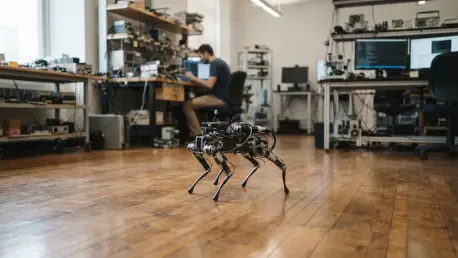
The TUCmouse represents a significant milestone in the evolution of minimalist robotic platforms, tracing its mechanical lineage back to sophisticated rodent-inspired models. Designed to emulate the skeletal proportions and articulated movements of a common rat, the platform serves as a rigorous testbed for exploring how much spatial information can be extracted from a limited sensor suite. Unlike previous iterations that featured complex tactile arrays and pressure-sensitive foot pads, the current version of the TUCmouse intentionally omits these sensors to focus on pure inertial and kinematic estimation. This minimalist philosophy forces a greater reliance on advanced software and internal modeling, challenging researchers to find innovative ways to infer ground contact and movement cycles without direct feedback. The result is a system that is lighter, more energy-efficient, and more robust, as it lacks the fragile external components that often fail in unpredictable real-world environments.
In addition to its simplified sensing, the platform retains essential biomimetic features that contribute to its navigational capabilities, such as an isomorphic leg structure and a flexible, articulated spine. These features allow the robot to move with the agility of a living organism, but they also introduce complex dynamics that must be accounted for in the navigation model. The active tail and spine, while beneficial for balance and maneuverability, create lateral oscillations that appear as noise in the inertial data. To manage this, the robot’s software must distinguish between the purposeful movements of the spine and the actual translation of the body through space. This is achieved through a sophisticated understanding of the robot’s forward kinematics, where the expected movement of each limb is compared against the actual inertial feedback. By integrating these mechanical insights into the navigation filter, the TUCmouse demonstrates that high-level spatial awareness is possible even on a platform that prioritizes mechanical simplicity over sensory density.
Strategies for Reliable Position Estimation
Developing a reliable sense of position requires a multi-layered approach that combines traditional mechanical principles with modern computational techniques. In 2026, the most effective strategies for robot localization involve a hierarchical structure where basic kinematic data provides a coarse estimate of movement, which is then refined by more complex statistical filters. For small robots, this often begins with identifying the fundamental units of motion—steps. By treating each step as a discrete event with a known length and orientation, the system can build a basic trajectory. However, this method is highly susceptible to errors from foot slippage and changes in the environment, such as moving from a carpeted surface to a smooth wood floor. To address these variations, the navigation system must incorporate real-time feedback that adjusts the expected step length and heading based on the observed dynamics of the robot’s movement, creating a more flexible and accurate representation of its path.
The integration of these various data streams is managed by a central algorithm that must reconcile often-conflicting information from accelerometers, gyroscopes, and motor controllers. This process of sensor fusion is what allows the robot to maintain a stable estimate of its state even when individual sensors fail or provide noisy data. By weighting each source of information based on its current reliability—for instance, trusting the gyroscopes more during fast turns and the kinematic models during steady walking—the system can navigate through a wide range of scenarios. This strategic approach to data management is what separates modern bio-inspired robots from their predecessors, enabling them to operate with a level of autonomy and resilience that was previously impossible. As these systems continue to evolve, the focus is shifting toward even tighter integration between the physical dynamics of the robot and the software that controls it, leading to navigation solutions that are both highly efficient and exceptionally robust.
Kinematic Constraints and Step Counting
One of the primary methods for estimating a robot’s displacement involves the use of foot kinematics, which relies on the geometry of the legs and the commanded joint angles to predict movement. If the system assumes that a foot in the stance phase remains firmly anchored to the ground, the body’s translation can be calculated as the inverse of the leg’s movement relative to the torso. This method is particularly useful in environments where inertial data is heavily compromised by vibration. However, physical interaction often involves significant slippage, especially on smooth or uneven surfaces. In such cases, a purely kinematic model will consistently overestimate the distance traveled, as it cannot “see” the foot sliding across the floor. To mitigate this, researchers have implemented adaptive kinematic models that use inertial feedback to detect when slippage is occurring, allowing the system to adjust its displacement estimates in real time to reflect the actual progress made.
Complementary to kinematic modeling, orientation-aided step counting treats locomotion as a series of discrete spatial updates. By identifying characteristic peaks in vertical acceleration that signal a foot strike, the robot can count its steps and multiply them by a nominal step length to estimate distance. While this approach is relatively simple to implement, its accuracy depends heavily on the consistency of the robot’s gait and the stability of its heading estimate. Heading drift, in particular, can cause the estimated trajectory to curve away from the actual path, even if the distance calculation is correct. To address this, 2026-era systems often use low-level sensor fusion within the inertial unit to maintain a more stable orientation estimate. By combining step counting with improved orientation data, robots can achieve a reliable baseline for navigation that serves as a vital fallback when more complex filtering methods face computational or sensory constraints.
The Extended Kalman Filter Framework
The most sophisticated method for indoor localization in small, legged robots involves the Extended Kalman Filter, a mathematical framework that excels at fusing noisy sensor data with a dynamic model of a robot’s movement. In the TUCmouse platform, the filter manages an eight-dimensional state vector that includes 2D position, velocity, yaw orientation, and the systematic biases of the inertial sensors. The power of the filter lies in its two-stage operation: prediction and correction. During the prediction phase, the filter uses high-frequency data from the accelerometers and gyroscopes to project the robot’s state forward in time. This provides a continuous estimate of movement but is subject to the rapid accumulation of integration errors. To counter this, the correction phase utilizes pseudo-measurements derived from the robot’s gait cycle, such as kinematic velocity and critical zero-velocity updates that act as a “braking” mechanism to prevent the filter from drifting during pauses.
By explicitly modeling sensor biases within the state vector, the filter learns to compensate for the drift that plagues raw inertial data. As the robot moves, the filter compares its inertial predictions against the constraints provided by its kinematics. If the accelerometers suggest the robot is moving forward while the kinematic model indicates the feet are stationary, the filter identifies this discrepancy and updates its bias estimates accordingly. This self-calibrating nature allows the system to maintain accuracy over hundreds of steps, effectively “taming” the noise inherent in low-cost hardware. Furthermore, using zero-velocity updates during the brief moments when a foot is firmly planted ensures that the velocity estimate is periodically reset to zero, halting the growth of integration errors. This combination of predictive modeling and opportunistic correction creates a robust navigation solution that far exceeds the performance of any single sensing modality, providing a stable foundation for autonomous behavior.
Analyzing Navigation Performance and Future Goals
The analysis of experimental data from 2026 reveals a clear hierarchy in the effectiveness of different proprioceptive navigation strategies. While the raw integration of inertial data proved entirely unviable due to immediate error divergence, and simple kinematic models struggled with environmental variables like surface friction, the integrated sensor fusion approach demonstrated remarkable resilience. Experiments conducted on various surfaces, ranging from polished wood to high-grip polymers, showed that a robot’s ability to adapt its internal model to external conditions is the single most important factor in localization accuracy. These trials also highlighted the impact of mechanical complexity, such as the oscillations introduced by an active spine, which can both hinder and help navigation depending on the surface and gait speed. This data-driven insight is guiding the next phase of development, which focuses on creating navigation systems that are as dynamic and adaptable as the physical platforms they control.
Looking forward, the goal is to expand these localized navigation successes into a more comprehensive, multimodal sensing suite. By integrating the current inertial and kinematic framework with tactile sensors and minimalist vision systems, researchers aim to create robots that can navigate entirely unknown and unstructured environments. This will involve moving beyond simple 2D position estimation toward full 3D spatial awareness, allowing robots to climb obstacles and navigate uneven terrain with the same confidence they currently display on flat floors. The ultimate vision is to produce autonomous systems that do not just follow a path, but actively understand their physical relationship with the world around them. As these technologies continue to mature, the lessons learned from platforms like the TUCmouse will serve as a blueprint for the future of mobile robotics, where the intelligence of the software and the agility of the hardware are perfectly synchronized for reliable, long-term operation.
Comparative Analysis and Spine Dynamics
Recent performance evaluations conducted in controlled environments have provided deep insights into how mechanical features like an active spine influence navigational accuracy. While a rigid spine offers a more stable platform for inertial sensing, the biomimetic undulation of an active spine is essential for the agility and balance required in complex maneuvers. Researchers observed that these lateral oscillations introduce a specific frequency of noise into gyroscope data, which can initially confuse a standard navigation filter. However, by incorporating the spine’s actuation frequency into the state-space model, the filter was able to distinguish between body sway and actual changes in heading. Interestingly, the interaction between the spine’s movement and surface friction played a major role in the results; on some surfaces, the rhythmic movement actually helped “settle” kinematic estimates by making foot-strike events more predictable, demonstrating that mechanical complexity is not always a detriment to sensing.
The comparative analysis also showed that while the Extended Kalman Filter outperformed all other methods, its success was highly dependent on the quality of the pseudo-measurements it received. When the robot operated on surfaces with high slippage, the kinematic velocity estimates became less reliable, forcing the filter to rely more heavily on zero-velocity updates to maintain stability. This highlighted the need for the navigation system to be “aware” of its environmental context. In the most successful trials, the robot achieved an endpoint error that was significantly lower than that of traditional step-counting methods, proving that the fusion of inertial and kinematic data can effectively mitigate the weaknesses of each individual source. These results confirmed that the key to accurate bio-inspired navigation is not just better sensors, but a more intelligent way of reconciling the physical realities of locomotion with the abstract data provided by the onboard electronics.
How does the EKF handle sensor drift?
The Extended Kalman Filter addresses sensor drift by treating it as a dynamic variable that can be estimated and corrected in real time. Rather than assuming that the accelerometer and gyroscope provide perfect signals, the filter maintains a state vector that explicitly includes the biases for each sensor axis. As the robot moves, the system compares the predicted position from the inertial data with the constraints of the kinematic model. If a consistent discrepancy is found—such as the robot appearing to move while kinematic data shows it is at a standstill—the filter attributes this difference to sensor drift and adjusts the bias terms accordingly. This constant recalibration ensures that systematic errors, which would normally lead to quadratic position drift, are kept in check, allowing for much more accurate long-term localization than would be possible through the simple integration of raw data.
Furthermore, the filter uses zero-velocity updates as a definitive reference point to reset velocity errors. During the specific phase of the gait when the robot’s forward motion is momentarily halted or a foot is firmly planted, the system knows that the actual velocity should be zero. By feeding this “pseudo-measurement” into the filter, any phantom velocity that has accumulated due to noise is immediately canceled out. This process mimics the way biological systems use external cues to periodically reset their internal sense of orientation. By combining this “braking” mechanism with the continuous estimation of sensor biases, the filter creates a stable and self-correcting loop. This approach proved highly effective in 2026 trials, where robots were able to maintain accurate position estimates over distances that would have previously caused total navigational failure, establishing a new standard for minimalist robotic proprioception.
Why is the TUCmouse considered a minimalist platform?
The classification of the TUCmouse as a minimalist platform stems from its intentional lack of the high-density, expensive sensing hardware typically found on modern autonomous robots. Most quadrupeds and complex mobile systems rely on a combination of LiDAR, multiple depth cameras, and high-precision contact sensors to understand their environment and movement. In contrast, the TUCmouse was designed to achieve similar navigational goals using only a basic inertial measurement unit and internal feedback from its motor controllers. This design choice was made to explore the limits of software-driven proprioception and to create a more resilient, low-power system that can operate without the heavy computational and electrical load of an extensive sensor suite. By focusing on the “intelligence” of the navigation algorithm rather than the complexity of the hardware, researchers created a platform that is highly efficient and capable of functioning in resource-constrained environments.
This minimalist approach also reflects a deeper biomimetic philosophy that emphasizes the resourcefulness of small biological organisms. Just as a rodent uses a combination of simple internal senses and tactile whiskers to navigate complex burrows, the TUCmouse uses its internal dynamics and frontal whiskers to achieve spatial awareness. In the trials completed throughout 2026, researchers demonstrated that this reduction in hardware does not necessarily lead to a reduction in capability. In fact, by removing the reliance on external sensors that can be easily obscured or damaged, the platform proved more robust in certain indoor scenarios. The project established that the future of small-scale robotics lies in the strategic fusion of basic data streams, where sophisticated filtering and bio-inspired modeling provide a level of performance that rivals much more complex and expensive systems. This shift toward “smart” minimalism was seen as a critical step in making autonomous robots more accessible and practical for wide-scale deployment.