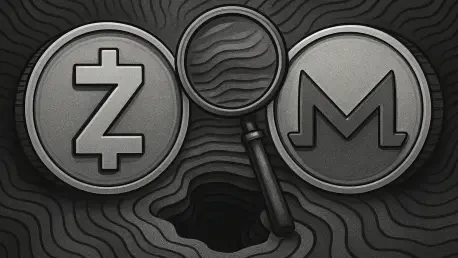

Selective disclosure through view keys enables Zcash users to provide transaction history to auditors or tax authorities without exposing their data to the general public. This capability addresses the persistent friction between the need for financial confidentiality and the mandates of institutional transparency. As of 2026, the digital finance sector remains deeply divided over the transparency inherent in legacy blockchains like Bitcoin, which utilize public ledgers that record every movement of funds for eternity. While early enthusiasts praised the pseudonymous nature of these networks, the reality is that once a public address is linked to a physical person or entity, the entire financial timeline of that user becomes open to any observer. This vulnerability has catalyzed the adoption of privacy coins, which employ sophisticated cryptographic protocols to mask the sender, recipient, and transaction value. By engineering privacy directly into the base layer, these assets provide a level of security that pseudonymous systems simply cannot match in an era of heightened surveillance.
Understanding the Core Mechanisms of Zcash
Zcash Architecture and Privacy Options
Zcash traces its origins back to 2016, establishing itself as a pioneer in utilizing advanced cryptographic proofs to provide financial anonymity. At its core, the protocol relies on a technology known as zk-SNARKs, which stands for Zero-Knowledge Succinct Non-Interactive Arguments of Knowledge. This mathematical breakthrough allows one party to prove to another that a statement is true without revealing any information beyond the validity of the statement itself. In the context of a cryptocurrency transaction, this means the network can confirm that the sender has sufficient funds and that the transaction is valid according to the protocol rules without revealing the sender’s address, the recipient’s address, or the specific amount of the transfer. This “zero-knowledge” approach creates a robust privacy layer that prevents the leakage of sensitive financial data, ensuring that personal spending habits and business transactions remain shielded from the prying eyes of the general public.
The evolution of Zcash has been marked by significant technical milestones that have enhanced the efficiency and accessibility of its privacy features. Significant upgrades, such as the transition to the Halo 2 proving system, eliminated the need for a “trusted setup,” which was a point of contention in earlier versions of the software. This transition not only increased the decentralization and security of the network but also significantly reduced the computational resources required to generate private transactions. By making shielded transactions faster and more memory-efficient, the protocol has moved toward a future where privacy is more practical for mobile devices and everyday use. This commitment to iterative improvement ensures that Zcash remains at the forefront of cryptographic innovation, providing a flexible framework for users who require various levels of visibility. Unlike many other assets, Zcash allows for a spectrum of privacy that can be adjusted based on the specific needs of the individual or the organization involved.
The Dual-Address System and Compliance
One of the most distinctive features of the Zcash ecosystem is its dual-address system, which offers users the choice between transparent and shielded interactions. Transparent addresses, often referred to as t-addresses, operate similarly to Bitcoin addresses, where transaction details are recorded publicly on the blockchain. Shielded addresses, known as z-addresses, utilize the aforementioned zk-SNARKs technology to encrypt all transaction data. This hybrid model allows users to move funds between transparent and shielded pools, providing a bridge between the traditional, transparent world of blockchain and the private environment of shielded transactions. For instance, a user might receive funds at a transparent address from a public exchange and subsequently move those funds into a shielded address to ensure their future financial activity remains private. This versatility is a major selling point for those who need to maintain a footprint in both worlds while still valuing their personal data.
This flexibility also plays a crucial role in how Zcash interacts with the global regulatory landscape. Because the protocol allows for selective disclosure, users can generate a view key that grants a specific third party the ability to see the transaction history associated with a shielded address. This is particularly relevant for businesses that must undergo audits or individuals who need to report their crypto holdings to tax authorities. By providing a pathway for compliance that does not sacrifice general privacy, Zcash positions itself as a sophisticated tool for institutional use. It acknowledges the reality that while individuals have a right to privacy, certain legal and financial frameworks require transparency. This balanced approach is designed to mitigate the risks of delisting from centralized exchanges while still offering the highest level of cryptographic security to those who choose to utilize the shielded features of the network.
Exploring Monero’s Default Privacy Standards
Monero’s Mandatory Anonymity Framework
Monero operates on a fundamentally different philosophy than Zcash, asserting that privacy is a human right that should be the default state for all financial interactions. Since its launch, the network has implemented a “privacy by default” model, meaning that every transaction occurring on the blockchain is automatically obscured. This mandatory approach is rooted in the concept of fungibility, which is the idea that every unit of a currency must be indistinguishable from another. In a transparent blockchain, certain coins can become “tainted” if they were previously used in illicit activities, potentially leading to their rejection by exchanges or merchants. Monero eliminates this risk by ensuring that no coin has a visible history. Every unit of XMR is equal to any other, preserving its utility as a medium of exchange. This uncompromising stance on privacy has made Monero the gold standard for those who prioritize total anonymity above all other factors.
The technical backbone of Monero consists of three primary technologies that work in unison to protect the anonymity of every participant. First, ring signatures are used to hide the identity of the sender by mixing their transaction with a group of decoy signatures. Second, stealth addresses are generated for every transaction, ensuring that the recipient’s public address is never linked to the payment on the blockchain. Finally, Ring Confidential Transactions, or RingCT, hide the specific amount of the transaction. By integrating these three layers into every single payment, Monero creates an environment where it is mathematically impossible for an outside observer to determine who sent what to whom. This collective shielding ensures that even if one user is compromised, the rest of the network remains secure. The mandatory nature of these features prevents users from inadvertently revealing their private activity, a risk that exists in systems where privacy is merely an optional setting.
Hiding Identity and Transaction Values
The implementation of ring signatures in Monero is a sophisticated method of ensuring sender anonymity. When a transaction is initiated, the sender’s digital signature is combined with several “outputs” from previous transactions on the blockchain. To an observer, any one of these signatures could be the actual sender, making it impossible to definitively trace the source of the funds. Over time, the network has increased the number of decoys required for each transaction, further strengthening the resistance against statistical analysis and forensic tracking. This mechanism ensures that the origin of a payment is always shrouded in ambiguity, providing a high degree of plausible deniability for every user. As computational power increases, the Monero community continues to optimize these signatures to maintain a high level of security without unnecessarily bloating the size of the blockchain, ensuring the network remains decentralized and accessible to those with modest hardware.
Complementing ring signatures are stealth addresses and RingCT, which address the other side of the privacy equation. Stealth addresses require the sender to create a unique, one-time address on behalf of the recipient. This means that even if a user receives hundreds of payments, no one looking at the blockchain can see that they are all going to the same person. This effectively breaks the link between a public identity and its transaction history. Meanwhile, RingCT ensures that the actual amount of XMR being transferred is hidden from the public. The network uses cryptographic commitments to prove that the amount of currency being sent is equal to the amount being received, preventing the creation of new coins out of thin air while keeping the denominations private. This multi-faceted approach ensures that Monero remains a truly confidential currency, providing a level of protection that is constant and reliable across all transactions, regardless of the user’s technical expertise.
Analyzing Market Positioning and Regulatory Challenges
Philosophical Differences and User Experience
The divergence between Zcash and Monero highlights a significant ideological split within the privacy-preserving cryptocurrency community. Zcash proponents argue that an opt-in model is essential for long-term viability, as it allows users to navigate the complexities of modern financial regulations while still maintaining the ability to shield their wealth. This perspective views privacy as a tool that should be available when needed but also recognizes that transparency can be beneficial in certain contexts, such as non-profit donations or corporate accounting. By providing the infrastructure for both modes of operation, Zcash seeks to be a versatile asset that can integrate with existing financial systems. This approach has led to various partnerships and institutional recognition, as it provides a framework that regulators find less threatening than a completely opaque system. It offers a bridge for those who want the benefits of blockchain without total exposure.
On the other hand, the Monero community maintains that privacy is only effective when it is universal. They argue that in an optional system like Zcash, the act of choosing privacy can itself be a signal that draws scrutiny. If only a small percentage of users shield their transactions, those users may be targeted by investigators who assume they have something to hide. By making privacy mandatory for everyone, Monero creates a “crowd” in which every user is hidden, regardless of their intent. This ensures that privacy is not a luxury or a suspicious choice, but a standard feature of the network. This philosophical commitment to total anonymity often puts Monero at odds with regulatory bodies, as it leaves no room for the selective disclosure features that Zcash utilizes. However, for many users, this rigidity is precisely what makes Monero the most trustworthy privacy coin available, as it removes the possibility of human error or coercion in the disclosure of transaction data.
Limits of Anonymity and the Regulatory Future
Despite the advanced nature of these privacy-preserving technologies, users must remain aware that no cryptocurrency offers a perfect “magic cloak” for total anonymity. True privacy extends beyond the blockchain ledger and involves many external factors. For example, if a user purchases Monero or Zcash through a centralized exchange that requires comprehensive identity verification, a permanent link is established between their real-world identity and their initial entry into the privacy ecosystem. Furthermore, sophisticated network analysis can sometimes reveal metadata such as IP addresses or transaction timestamps, which could potentially be used to de-anonymize a user. This highlights the importance of using additional tools like VPNs, Tor, or specialized operating systems to ensure that the privacy provided by the coin is not undermined by vulnerabilities at the network layer. As we move from 2026 to 2028, the sophistication of blockchain forensics is expected to increase, making these holistic security practices even more critical for users.
Looking ahead, the regulatory landscape for privacy coins remains a complex and evolving challenge. Many jurisdictions have exerted pressure on exchanges to delist privacy-centric assets like XMR and ZEC, citing concerns over their potential use in money laundering and other illicit activities. However, this pressure has also sparked a move toward decentralized exchanges and peer-to-peer trading platforms that are more resistant to censorship. At the same time, institutional interest in privacy-preserving technology continues to grow, as evidenced by the development of zero-knowledge proofs for enterprise applications. The demand for financial privacy is not going away; if anything, it is intensifying as more of our lives move into the digital realm. The ongoing development of Zcash and Monero will likely serve as a blueprint for how future digital assets balance the need for personal security with the requirements of a global, regulated financial system. Their survival and adaptation will define the boundaries of digital freedom in the coming years.
Navigating the Privacy Frontier
The historical development of privacy coins has demonstrated that protecting financial data required more than simple pseudonymity. Users who prioritized maximum anonymity often turned to Monero, while those who required a path toward regulatory compliance found Zcash to be a more suitable alternative. Both projects advanced the field of cryptography significantly, proving that zero-knowledge proofs and ring signatures were viable for global, decentralized networks. In the long term, the most effective strategy for individuals and businesses was to understand the specific strengths and weaknesses of each asset before integrating them into their financial workflows. As forensics became more precise, the community recognized that privacy was a continuous process rather than a one-time setup. Moving forward, the industry started focusing on layer-2 privacy solutions and cross-chain confidentiality, ensuring that the lessons learned from Zcash and Monero were applied to the broader blockchain ecosystem to safeguard the future of digital transactions.