
The rapid convergence of physical aerospace engineering and digital spatial computing is currently dismantling the traditional boundaries of how aircraft are designed, maintained, and operated across the globe. As the aviation industry navigates the complexities of a post-pandemic recovery and a shifting geopolitical landscape, the adoption of immersive technologies has moved from the periphery of research to the core of operational strategy. By 2035, the integration of Augmented Reality and Virtual Reality will no longer be viewed as a futuristic novelty but as a foundational pillar of aeronautical safety and efficiency. This transition represents a fundamental rethinking of the human-machine interface, where data is not just read from a screen but experienced within a three-dimensional context. As these digital tools become more sophisticated, they allow airlines and manufacturers to bridge the widening gap between human capability and the increasing mechanical complexity of modern fleets. The journey toward the next decade is fueled by a critical need to solve labor shortages and rising costs, turning the market into a powerhouse of data-driven precision where every technician and pilot is supported by immersive intelligence. By blending physical environments with digital intelligence, these tools allow the sector to redefine safety and resilience in an increasingly volatile global economy.
Financial Trajectory: Mapping Market Expansion to 2035
The financial roadmap for immersive technologies in the aviation sector suggests a decade of aggressive expansion and deep capital commitment from both private and public entities. Starting from a valuation that exceeded eight billion dollars in 2025, the market is currently experiencing a robust compound annual growth rate of approximately 13 percent, placing it on a trajectory to nearly triple its value by the mid-2030s. This growth is driven by the decreasing cost of high-performance hardware and the maturing ecosystem of software developers specializing in aerospace applications. Investors are increasingly focusing on the long-term returns offered by reduced downtime and improved training outcomes, viewing these tools as essential for maintaining a competitive edge in a crowded marketplace. Furthermore, as the hardware becomes more ergonomic and less expensive, smaller regional carriers and general aviation operators are beginning to find these tools accessible, democratizing access to high-end simulation and maintenance support that was once reserved for only the largest global players.
A significant portion of this market expansion is rooted in the move away from standalone virtual environments toward fully integrated digital ecosystems that leverage real-time data streams. Future operations will increasingly rely on the concept of the digital twin, where every physical aircraft in a fleet has a virtual counterpart that mirrors its condition, flight history, and maintenance needs in real-time. By 2035, these digital twins will be accessible through immersive interfaces, allowing fleet managers to virtually inspect an engine located on another continent to diagnose a vibration or wear pattern. This level of connectivity ensures that financial investments in AR and VR are not just spending on visual aids but are investments in a broader data architecture that enhances decision-making. The transition to this model allows for a more proactive approach to asset management, where predictive analytics and immersive visualization work in tandem to prevent mechanical failures before they occur, ultimately stabilizing the financial volatility often associated with aircraft maintenance and unscheduled grounding events.
Learning Revolution: Impact on Training Efficiency
The evolution of aviation training protocols is perhaps the most visible manifestation of this digital transformation, as Virtual Reality transforms the way knowledge is transferred to the next generation of aviators. Traditional classroom settings and static manuals often fail to provide the visceral context needed for high-stakes decision-making, leading to lower retention rates and longer learning curves. In contrast, VR training creates an active lived event where the trainee’s brain processes the simulation as a physical experience, leading to knowledge retention rates that significantly outperform conventional methods. This cognitive engagement is crucial for an industry that must rapidly train thousands of new pilots and cabin crew members to meet the burgeoning global demand for air travel. By 2035, the standard for proficiency will be measured not just by hours in a cockpit but by the depth of scenarios navigated within a synthetic environment, ensuring that every crew member is prepared for the rarest of emergencies through repeated, immersive exposure.
Beyond the qualitative benefits of better retention, the adoption of immersive learning environments offers a massive quantitative boost to the efficiency of workforce development programs. Current data indicates that technicians and flight crews can reduce their total training hours by nearly half when using high-fidelity virtual simulations for complex procedural tasks. This efficiency allows airlines to move personnel through the pipeline much faster without compromising on the quality of instruction or the safety of operations. By eliminating the need to ground physical aircraft for training purposes or burn thousands of gallons of fuel for repetitive maneuvers, carriers can redirect their resources toward revenue-generating flights. This shift is particularly vital as the industry faces a looming shortage of qualified staff, making the ability to produce peak-ready professionals in a shorter timeframe a critical strategic advantage. The cost savings realized through these virtual platforms are being reinvested into more advanced software, creating a virtuous cycle of continuous improvement in training standards through the late 2020s.
Virtual Reality: Setting the Simulation Standard
Virtual Reality has solidified its position as the dominant technology for total immersion, serving as the primary vehicle for high-stakes simulation in the aerospace sector. It provides a completely synthetic environment where pilots can practice complex maneuvers or life-saving emergency protocols without any real-world risk to themselves or the equipment. This capability is invaluable for training on maneuvers that are either too dangerous or too expensive to perform in a physical aircraft, such as total engine failure during takeoff or severe weather transitions. By 2035, these virtual environments will be so photorealistic and physically accurate that the sensory gap between the simulator and the actual aircraft will be virtually indistinguishable. Flight schools are already integrating these headsets to supplement full-motion simulators, allowing students to master cockpit layouts and switch patterns in a cost-effective virtual space before ever sitting in a multi-million-dollar training device, thus maximizing the value of every minute spent in actual flight training.
The utility of Virtual Reality extends far beyond the cockpit and into the initial stages of aircraft design and engineering where it serves as a powerful tool for spatial optimization. Designers and engineers are now using immersive virtual spaces to walk through aircraft interiors and inspect mechanical configurations before a single physical prototype is manufactured. This virtual walkthrough allows for the early identification of potential flaws in cabin layouts, such as ergonomic issues for cabin crew or accessibility challenges for passengers, which might not be apparent on a two-dimensional screen. By catching these design inconsistencies during the digital phase, manufacturers can avoid the staggering costs of redesigning components or retrofitting aircraft already on the production line. This proactive approach to engineering not only saves millions of dollars but also accelerates the time-to-market for new aircraft models, allowing manufacturers to respond more quickly to changing market demands and environmental regulations through 2035 and beyond.
Operational Impact: Augmented Reality in the Hangar
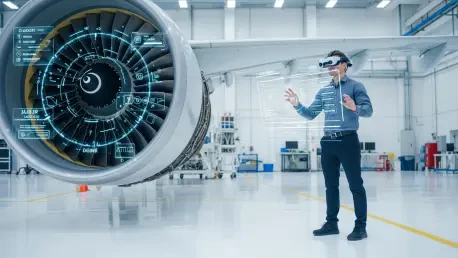
While Virtual Reality is the king of simulation, Augmented Reality is rapidly becoming the essential tool for real-time operational environments, particularly within the demanding sphere of aircraft maintenance. AR systems act as a digital assistant for technicians, projecting step-by-step assembly instructions, torque requirements, and technical schematics directly onto the physical parts they are working on. This hands-free workflow is a significant departure from traditional methods that required mechanics to constantly consult tablets or paper manuals, often located several feet away from the actual component. By keeping the technician’s eyes on the task and their hands on their tools, AR drastically reduces the cognitive load and the potential for human error during complex repairs. As maintenance tasks become increasingly intricate with the advent of composite materials and advanced avionics, the real-time guidance provided by AR ensures that every action is performed with surgical precision, enhancing the overall safety and reliability of the fleet.
One of the most transformative features of Augmented Reality in aviation is the see-what-I-see capability, which allows for instantaneous remote assistance across geographical boundaries. A junior mechanic stationed at a remote airfield can wear an AR headset and broadcast their exact field of vision to a senior engineer located at a centralized headquarters thousands of miles away. The expert can then overlay digital markers or drawings onto the junior mechanic’s view, guiding them through a complex repair as if they were standing right beside them. This democratization of expert knowledge is crucial for reducing aircraft on ground time, which can cost airlines tens of thousands of dollars for every hour a plane is out of service. By 2035, this collaborative model will be the standard for global maintenance networks, ensuring that the highest level of expertise is always available at the point of need, regardless of where an aircraft happens to land. This connectivity not only improves operational efficiency but also serves as a continuous on-the-job training mechanism for less experienced staff.
Precision Standards: Enhancing Inspection and Maintenance
The application of Augmented Reality is also refining the pre-flight inspection process, adding a layer of digital oversight that was previously impossible with manual checks alone. By overlaying digital checklists and historical maintenance data onto the physical fuselage and engines, AR systems can highlight specific areas of an aircraft that require immediate attention or have shown signs of wear in previous reports. This ensures that no bolt is left uninspected and no hydraulic leak goes unnoticed, as the technology requires the inspector to verify each digital marker before the inspection can be finalized. This systematic approach eliminates the risk of checklist fatigue and provides a verifiable digital trail of every inspection performed. By 2035, this level of precision will be integrated with sensor data from the aircraft itself, creating a redundant safety system where the human eye and digital intelligence work in perfect harmony to guarantee the airworthiness of every flight before it leaves the gate.
Airlines are finding that they can no longer rely on traditional training pipelines to meet their staffing needs, necessitating a shift toward scalable and more efficient digital platforms. These immersive tools allow for a consistent standard of training to be deployed across a global network of flight schools, ensuring that a trainee in Sydney receives the exact same high-quality instruction as one in London or New York. The data-rich nature of VR and AR platforms also allows instructors to track a student’s progress with unprecedented precision, identifying specific areas where a trainee might be struggling and tailoring the curriculum to address those weaknesses. This personalized approach to learning not only improves graduation rate but also ensures that every new hire enters the workforce with a higher baseline of competency and confidence. Over the coming years through 2035, the refinement of these data analytics will allow for predictive training models that anticipate where errors are likely to occur based on a student’s previous interactions.
Market Segmentation: Specialized Applications and MRO
The Maintenance, Repair, and Overhaul sector is the second-largest beneficiary of immersive tech, using these tools to solve logistical bottlenecks and bridge the growing skills gap in the technical workforce. As aircraft engines and systems become more complex, the time required to master their maintenance increases, putting pressure on MRO providers to keep their staff updated on the latest configurations. Immersive tools allow these providers to offer just-in-time training and support, where a technician can learn the specifics of a new engine type through a virtual module just hours before they begin working on the physical unit. This flexibility is essential for maintaining the fast turnaround times that airlines demand, as it reduces the need for lengthy off-site training courses. By 2035, the integration of AR into the MRO workflow will be so seamless that it will be considered an essential part of the technician’s toolkit, as necessary as a wrench or a diagnostic computer for ensuring the longevity and safety of the global fleet.
Beyond the aircraft itself, immersive technologies are finding significant roles in airport management and the overall passenger experience, creating a more streamlined journey from the curb to the gate. For airport ground crews, VR simulations are used to practice aircraft marshaling, baggage handling, and refueling in a safe environment, reducing the risk of ground accidents in busy tarmac areas. Meanwhile, passengers are beginning to benefit from AR-powered wayfinding applications on their smartphones, which can guide them through massive, complex terminals by overlaying directional arrows onto their real-world view. This technology helps reduce the stress of travel and ensures that passengers can find their gates, lounges, or amenities with minimal confusion. By 2035, these applications could evolve into integrated wearable devices that provide travelers with real-time updates on flight status and personalized terminal navigation, further digitizing the airport environment and improving the overall efficiency of hub operations.
Regional Leadership: Global Trends and Regulatory Influence
North America currently maintains a leading position in the global market for immersive aviation technology, supported by a massive aerospace manufacturing base and a robust defense sector that serves as an incubator for innovation. Major industry players have been early adopters of AR and VR, integrating these tools into the production of next-generation aircraft and the training of military aviators. The presence of a sophisticated technological infrastructure and a high concentration of software developers has allowed for the rapid testing and deployment of new immersive solutions. Furthermore, regional regulators in North America have been proactive in establishing clear guidelines for the certification of virtual training devices, providing the legal certainty needed for airlines to invest heavily in these technologies. This synergy between manufacturing, defense, and regulation ensures that the region will continue to set the standard for immersive aviation applications as we move toward the mid-2030s.
In contrast to the established markets, the Asia-Pacific region is emerging as the fastest-growing market for immersive aviation tools, driven by an explosive demand for air travel and a willingness to adopt digital-first solutions. Countries like China and India are skipping older, legacy training models in favor of the latest virtual platforms to rapidly scale their aviation workforces and support their expanding fleets. The massive infrastructure projects and new airport developments in this region provide a blank slate for the integration of smart technologies, including AR-based management systems and VR-led staff training centers. This region is quickly becoming a global testing ground for large-scale immersive learning programs, as airlines seek the most efficient ways to train thousands of new pilots and technicians. The agility of the Asia-Pacific market, combined with significant government backing for digital transformation, positions it to become a primary driver of industry-wide innovation over the next nine years.
Regional Innovation: Europe and the Middle East Hubs
Europe continues to serve as a vital hub for engineering innovation, particularly in the manufacturing and design phases of aircraft development where precision is paramount. European companies are at the forefront of using Augmented Reality for complex assembly tasks and Virtual Reality for environmental testing of new cabin configurations, reflecting a deep-seated culture of craftsmanship and technical excellence. Simultaneously, the Middle East is carving out a unique niche by focusing on the luxury passenger experience and the creation of futuristic airport hubs in major metropolitan areas. These regions are utilizing immersive technologies to push the boundaries of what is possible in airport design and inflight service, viewing digital tools as a way to enhance their global reputation for excellence. Each of these regions brings a different focus to the table, but they are all moving toward a unified goal of a more digitized and efficient aviation future that will be fully realized by 2035.
Engineering teams across these regions are increasingly collaborating through shared virtual environments, allowing a designer in Toulouse to work on a fuselage model simultaneously with an engineer in Hamburg. This level of cross-border technical synergy reduces the lead times for major aerospace projects and ensures that the highest safety standards are applied consistently across international partnerships. By 2035, the geographical location of a design firm will be less relevant than the quality of its virtual collaborative tools, as spatial computing allows for a globalized workforce that operates in a unified digital hangar. This shift not only accelerates innovation but also fosters a more integrated global aerospace community where the best ideas can be tested and implemented regardless of where they originate. The Middle Eastern investment in ultra-modern airports serves as the physical anchor for these digital developments, providing the infrastructure needed to support the high-speed data transfers required by pervasive immersive technology.
Strategic Challenges: Navigating Costs and Technical Hurdles
Despite the overwhelming evidence of their benefits, the widespread adoption of immersive technologies in aviation still faces significant hurdles, primarily regarding high initial costs and the rigor of safety certification. Developing high-fidelity virtual environments and purchasing the necessary hardware requires a substantial upfront investment, which can be a barrier for smaller operators or those with tight profit margins. Moreover, proving to regulatory bodies that a virtual simulation is as effective as training in a physical aircraft is a slow and data-intensive process. Aviation authorities must be certain that these digital tools do not introduce new risks or lead to a gamification of safety-critical tasks. Balancing the need for rapid innovation with the industry’s uncompromising commitment to safety remains a primary challenge for developers and airlines alike as they work to integrate these tools into the standard operating procedures over the next decade.
Technical limitations also play a role in the pace of adoption, as the current generation of hardware still struggles with issues such as battery life, the physical weight of headsets, and a limited field of vision for certain tasks. For an AR headset to be useful for a technician during a full shift, it must be comfortable, durable, and capable of operating without constant recharging. Additionally, as these immersive systems become more deeply integrated into an airline’s digital backbone, they become potential targets for cyber threats. Protecting the integrity of the data streams that feed into VR simulators and AR headsets is a top priority, requiring robust encryption and cybersecurity protocols to prevent unauthorized interference. Ensuring that these tools are not only powerful but also secure and user-friendly is essential for their long-term viability in an industry where reliability is the most important metric of success. Developers are working closely with cybersecurity experts to build resilience into every layer of the spatial computing stack.
Future Integration: Realizing the 2035 Digital Vision
Looking toward 2035, the future of the aviation market lies in the seamless integration of Artificial Intelligence and digital twins that update in real-time within immersive environments. This evolution will allow for a level of operational foresight that was previously unimaginable, where every stakeholder from the pilot to the maintenance engineer has access to a perfect, data-driven representation of the aircraft’s state. AI will play a critical role in this ecosystem, automatically highlighting potential issues in an AR display or adjusting a VR training scenario to challenge a student’s specific weaknesses. The transformation will fundamentally change the boundaries of aviation safety, making the skies more efficient, predictable, and resilient than ever before. By the mid-2030s, immersive technology will likely be as standard in a hangar or cockpit as a wrench or a flight computer, representing the final step in the industry’s journey from mechanical traditionalism to digital mastery.
The journey toward a fully immersive aviation ecosystem was ultimately characterized by a collective commitment to safety and a strategic embrace of technological disruption. As the industry moved through the late 2020s and into the early 2030s, the early experimental phases of Augmented and Virtual Reality matured into standardized protocols that governed every aspect of flight operations. The successful integration of these tools provided the necessary framework for managing the increased complexity of modern aircraft while simultaneously addressing the critical labor shortages that once threatened to ground the sector. Organizations that prioritized the early adoption of spatial computing found themselves at a distinct advantage, benefiting from reduced operational costs and a more proficient workforce. The journey to 2035 demonstrated that the path to a safer sky was paved with digital intelligence, proving that the synergy between human expertise and immersive visualization was the key to unlocking the next era of global aviation. Aviation leaders realized that the investment in spatial computing was not merely a technical upgrade but a necessary evolution for the industry’s long-term survival.