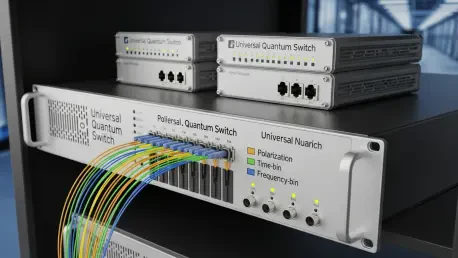

Quantum networking only becomes valuable when unlike machines speak the same fragile language across ordinary fiber links that span buildings, cities, and continents without sacrificing entanglement. That is the bet behind Cisco’s prototype universal quantum switch, a room‑temperature device intended to interconnect disparate quantum systems by “translating” between multiple qubit encodings over existing telecom infrastructure. Instead of building a quantum processor, Cisco targeted the connective layer: polarization today, with time‑bin, frequency‑bin, and path on the roadmap. Early lab results cited average losses under 4% in encoding and entanglement fidelity, a promising figure that still must stand up outside controlled benches. The strategy positioned Cisco as a neutral broker across hardware vendors, aiming to curb lock‑in and hasten real‑world pilots where quantum advantages will likely arrive first in security and sensing rather than full‑blown distributed computing.
Interoperability As Wedge
Cisco’s approach foregrounded interoperability as the shortest bridge between quantum proofs and deployable networks, using a universal switch to preserve qubit states while mapping among polarization, time‑bin, frequency‑bin, and path encodings. The choice to operate at room temperature over standard single‑mode fiber mattered: it sidestepped exotic cryogenics at intermediate nodes and aligned with carrier facilities already optimized for dense wavelength‑division multiplexing and strict power budgets. In practical terms, the device functioned like a translation plane for entanglement distribution, allowing a photon prepared in one format to be routed and delivered in another without collapsing its quantum information. The company reported proof‑of‑concept validation in polarization first, with broader format support pending qualification, reflecting a staged plan that could, if successful, slide into metro rings and data‑center interconnects with minimal civil works.
Building on this foundation, the strategic arc naturally turned to standards. History showed that networking value accrued to those who codified how diverse gear talked, not only to those who shipped the fastest chips. By advocating common control surfaces and measurement semantics for quantum links—think unified visibility into loss, fidelity, and timing jitter—the switch doubled as leverage in bodies such as ETSI and ITU‑T study groups, where interface profiles and conformance tests set the pace. That stance countered a gravitational pull toward vertically integrated stacks from processor makers guarding bespoke encodings. It also mirrored classical playbooks: interoperability discouraged stranded investments and encouraged cloud and carrier adoption, because a neutral interconnect reduced switching costs between vendors. Analysts read the move as a bid to define the connective tissue of a future quantum internet while others contested supremacy at the processor and algorithm layers.
Security First, Scale Later
In the near term, security use cases offered the most credible ramp to revenue, long before continent‑spanning entanglement became routine. An enterprise could deploy entanglement‑based monitoring along a critical fiber span: by distributing entangled photon pairs across a link and watching correlations at endpoints, the system flagged eavesdropping attempts that disturb quantum statistics. Folded into existing SOC tooling through APIs, such alerts became another signal alongside NetFlow data and IDS events, with the universal switch handling format conversions so detection logic did not depend on a single qubit encoding. Carriers could pilot managed “quantum‑assured” links between data centers, while cloud providers tested short‑haul connections among availability zones to harden inter‑AZ replication. Crucially, any claimed sub‑4% average loss and high fidelity had to persist across splices, amplifiers, and real metro noise, or the operational false‑positive rate would erase security gains.
The decisive steps for stakeholders had been clear. Enterprises started by mapping candidate fiber segments for limited pilots, prioritizing paths with existing dark channels and strict compliance demands, then insisted on vendor‑agnostic conformance tests that measured end‑to‑end fidelity, insertion loss, and stability over weeks, not hours. Carriers integrated the switch into lab networks to validate coexistence with DWDM, ROADM control, and optical power budgets, publishing telemetry schemas that exposed quantum KPIs to NOCs. Hardware makers that relied on unique encodings drafted translation profiles and test vectors so cross‑vendor flows could be certified. Policymakers focused on profiles and procurement language that rewarded open interfaces, while investors tracked milestones: sustained sub‑4% loss at metro distances, verified time‑ and frequency‑bin support, and signed trials with at least one cloud region and one Tier‑1 operator. Taken together, these moves had turned an ambitious lab demo into a staged path toward carrier‑grade quantum connectivity.