
The silent hum of massive server farms has shifted from a steady rhythm to a high-pitched roar as the world pivots toward specialized intelligence hubs. As the global digital economy expands from 2026 to 2028, the traditional distinction between storing data and processing it has become a fundamental rift in architectural design. While cloud storage facilities have long served as the backbone of the internet by hosting website files and personal backups, the rise of generative AI has necessitated a more aggressive infrastructure. These new AI data centers are not merely larger versions of their predecessors; they are precision-engineered environments built to sustain the brutal computational loads required for model training. This evolution marks a transition from passive digital libraries to active cognitive engines, where the primary objective is no longer just the preservation of information but its rapid synthesis into actionable intelligence for a global user base.
Specialized Processing Architectures: CPUs Versus GPUs
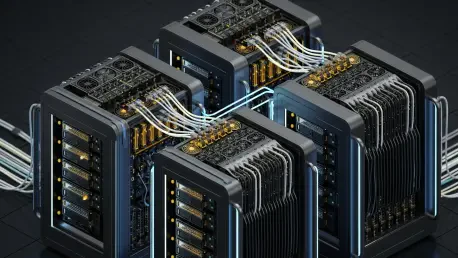
The most visible departure from traditional data center models lies in the internal hardware components, specifically the choice between Central Processing Units and Graphics Processing Units. Traditional cloud storage centers function effectively using high-end CPUs, which act as versatile generalists capable of managing sequential tasks like directing web traffic or updating customer records. However, AI data centers are built around the massive parallel processing power of GPUs and specialized Tensor Processing Units. These chips are engineered to perform thousands of simultaneous mathematical operations, which is a fundamental requirement for training the deep neural networks that define current technology. While a standard cloud server might prioritize balance and broad compatibility, an AI-focused server rack is essentially a supercomputing node designed for raw, specialized throughput that would overwhelm a general-purpose processor in minutes. This hardware choice dictates the entire power and cooling strategy.
Beyond the chips themselves, the networking architecture connecting these components represents a radical shift in how engineers approach data center connectivity and communication. In a standard cloud storage environment, servers frequently act as independent silos that respond to external requests with relatively low internal crosstalk between different racks. AI data centers, conversely, utilize high-speed networking fabrics such as InfiniBand to create a unified computing cluster where thousands of GPUs work as a single entity. This low-latency interconnection is vital because machine learning models often exceed the memory capacity of a single chip, requiring data to flow across the entire network with almost zero delay. This shift from isolated storage units to a tightly coupled, interconnected computational fabric distinguishes the AI facility as a collaborative system rather than a collection of independent storage drives in a building. It creates a seamless pool of resources.
Infrastructure Design: Thermal Management and Data Access
As power density within these facilities reaches unprecedented levels, the methods used to prevent hardware failure have transitioned from standard air circulation to advanced liquid cooling. Cloud storage facilities typically rely on hot and cold aisle containment systems, using massive fans to move chilled air through the server racks to keep components within a safe operating temperature. While this is sufficient for the relatively steady and lower-wattage demands of storage drives and CPUs, AI clusters generate thermal loads that exceed the heat-carrying capacity of air. Modern AI data centers are increasingly adopting direct-to-chip liquid cooling or immersion cooling, where servers are submerged in specialized non-conductive fluids. These methods allow for much higher server density, enabling operators to pack more computational power into a smaller physical footprint while significantly reducing the energy overhead required for traditional air conditioning units.
The management of information within these facilities also requires a departure from traditional file system protocols toward high-performance solutions like Non-Volatile Memory Express. Cloud storage is primarily concerned with data durability and long-term retention, often utilizing slower but more cost-effective storage tiers for files that are not frequently accessed. AI workloads, however, demand instantaneous access to massive datasets of unstructured information, including raw video, sensor logs, and sprawling text corpora used for large language model training. To satisfy these requirements, AI data centers implement high-throughput storage arrays that can feed data to the processors as fast as they can consume it. This eliminates the ‘I/O bottleneck’ that often plagues traditional servers, ensuring that the expensive GPU clusters remain fully utilized rather than waiting for data to arrive from a slower mechanical drive or a standard solid-state disk array.
Operational Scaling: Energy Dynamics and Strategic Insights
Scaling strategies have also undergone a major transformation, moving away from the horizontal growth common in cloud storage toward a more intensive vertical model. In a traditional cloud environment, increasing capacity is a straightforward process of adding more server racks to a facility or building a new warehouse to house additional storage drives. This horizontal expansion works well for services that need to store more photos or host more websites for a growing population. In contrast, AI operations prioritize vertical scaling, which involves maximizing the performance and power density of the existing footprint. Instead of just adding more space, engineers focus on increasing the energy delivery and cooling capacity per square foot. This allows the facility to tackle more complex intelligence tasks and larger model parameters, reflecting a focus on qualitative computational depth rather than just the quantitative storage volume found in standard cloud models today.
The industry recognized that the successful integration of artificial intelligence into daily operations required a complete reimagining of the underlying physical infrastructure. Stakeholders transitioned away from the one-size-fits-all approach of traditional cloud storage, opting instead for modular designs that prioritized specialized thermal management and high-density power delivery. This shift proved essential for maintaining competitive advantages, as organizations that invested in dedicated AI facilities saw significant improvements in model accuracy and deployment speed. Moving forward, it became clear that the focus must remain on optimizing the synergy between hardware and software to ensure long-term sustainability. Managers prioritized the implementation of automated monitoring systems to track the health of liquid-cooled systems and the efficiency of data pipelines. By embracing these architectural distinctions, the global tech landscape prepared itself for a future where computational intelligence was no longer a luxury but a fundamental utility.