
Relentless frame delivery rather than fleeting benchmark spikes set the tone for OnePlus’ latest gaming push, with the Ace 6 Ultra pitching a steadier path to victory by chaining silicon efficiency to oversized power reserves and input hardware built for reflex play under pressure. The claim was bold: consistent 165 frames per second across top titles, not just in brief bursts, but in hours-long sessions that stayed cool, quiet, and repeatable. That stance reframed the conversation around mobile gaming, shifting emphasis from headline SoC scores to the mechanics of maintaining high refresh without throttling or glare fatigue. It also created a clearer use case for a purpose-built controller that favored rear paddles and low-latency taps over twin joysticks. The result was a tightly defined device that treated sustained performance as the north star and designed around everything that could jeopardize it.
Sustained Speed: Silicon, Battery, and Display
At the center sat MediaTek’s Dimensity 9500, chosen specifically to prioritize GPU throughput and sustained efficiency. OnePlus cited the Mali-G1 Ultra 12-core GPU with more than double the prior generation’s ray tracing output, while CPU uplift arrived via an ARM C1-Ultra prime core, delivering a quoted 32% single-core jump and a 33% overall gain. Those boosts mattered less as raw bragging rights and more as insurance for the 165 Hz target: in Delta Force, the company claimed three hours locked at 165 fps at an average 4.6 W, an unusually low draw for that pace. The 8,600 mAh dual-cell battery anchored the strategy, reinforced by bypass charging that powered the phone directly during plugged-in play to suppress heat and limit cell wear. Fast top-ups filled 53% in 20 minutes and 100% in 49, while endurance estimates stretched to 7.4 hours of 165 fps gaming or 13.6 hours of navigation.
The 6.78-inch BOE OLED panel did the other half of the heavy lifting, translating throughput into feel with 1272 x 2772 resolution, full DCI-P3 coverage, and 10-bit color tuned for Dolby Vision and HDR10+. At 25% APL, peak brightness reached 3,600 nits, useful for outdoor matches where visibility could decide outcomes. To reduce eye strain during marathon runs, the panel used DC dimming above 70 nits, switching to high-frequency PWM below that threshold to smooth low-light flicker. Sound and touch feedback stayed competitive thanks to stereo speakers and an X-axis linear motor that produced crisp, short haptics instead of muddy buzz. Unlocks came via an ultrasonic in-display fingerprint reader, quicker and more forgiving than optical systems with damp fingers. Durability framing the whole rig was unusually robust for a gaming handset: an aluminum alloy chassis, tempered front glass, glass backs keyed to colorways, and IP66, IP68, and IP69K ratings protecting against dust, immersion, and high-pressure hot sprays.
Competitive Edge: Accessories, Trade-Offs, and Value
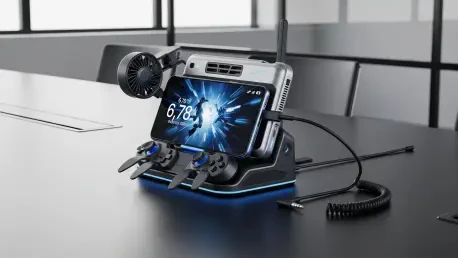
OnePlus paired the device with a controller that pushed competitive ergonomics rather than console mimicry. There were no joysticks or face buttons; instead, four rear paddles with a reported 1.8 ms response enabled clean macro-like actions and uninterrupted aiming on-screen. The accessory integrated an extra antenna for stronger signal, added a bottom USB-C pass-through to avoid cable interference, and included a 3.5 mm headphone jack for zero-latency audio. A magnetic mount accepted a separate clip-on cooling fan, signaling that thermal headroom remained a tactical lever for hardest pushes. The controller was retractable to accommodate other phones, broadening appeal, and landed at CNY 450 (about $65), a price low enough to tempt day-one bundles. Cameras stayed deliberately serviceable: a 50 MP 1/1.55-inch OIS main, an 8 MP 16 mm ultrawide, and a 16 MP 23 mm selfie. Video topped out at 4K60 on the rear and 1080p30 up front—sufficient for highlights, not a filmmaker’s rig.
Despite the gaming-first posture, the phone carried practical compromises that defined its ceiling. The USB-C port was limited to USB 2.0 speeds and lacked video output, cutting off easy desktop mirroring or TV play—an omission that undercut the obvious appeal of couch sessions with a wireless pad. Storage and memory tiers started at 12 GB/256 GB for CNY 3,800 (roughly $555) and reached 16 GB/1 TB for CNY 5,400 (about $790), with an initial CNY 300 discount softening early adoption. For prospective buyers, the smart move was to verify 165 fps support in favored titles, budget for the paddle controller and a clip-on fan to keep the envelope stable, and pick storage tiers with shader-heavy installs in mind. Developers aiming to meet players where the hardware now lived were best served by optimizing frame pacing at 165 Hz, exposing in-game toggles for decoupled charging, and profiling GPU load on Dimensity 9500 to hold power near the 4–5 W sweet spot. Competitors watching the playbook would have recognized that the fight had shifted from peak to persistence, and the winning response was to engineer around the grind rather than the graph.